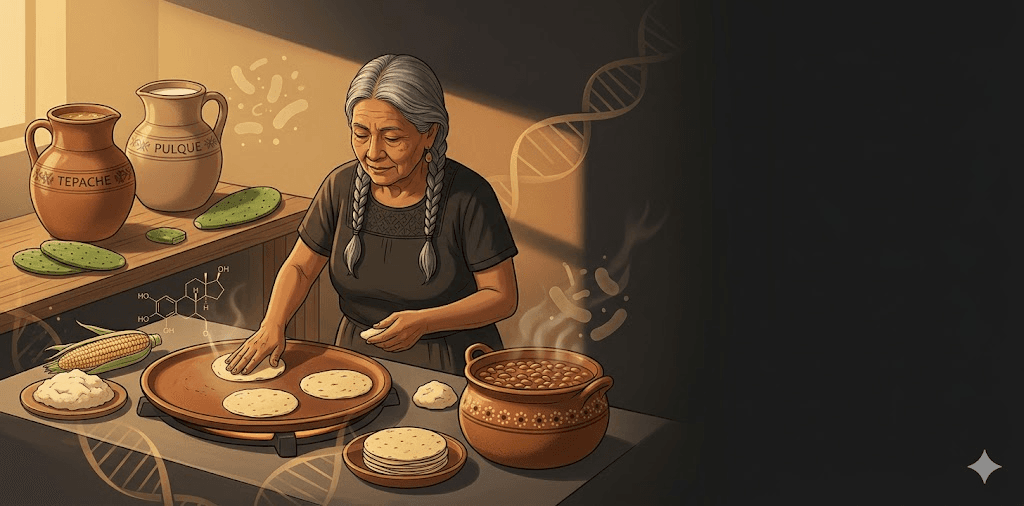
Hace cien años, una mujer mexicana promedio tomaba pulque o atole agrio varias veces por semana. Comía tortilla de masa nixtamalizada todos los días. Cocinaba frijoles con epazote. En algunas regiones, jocoque casero. En otras, pozol fermentado bajo hoja de plátano.
Hoy, 30% de la energía dietética mexicana promedio proviene de ultraprocesados [Marrón-Ponce et al., 2022, Journal of Human Nutrition and Dietetics]. Las mujeres latinas en Estados Unidos pierden la firma microbiana de Prevotella copri —marcador ancestral mesoamericano— por cada año adicional de aculturación alimentaria [HCHS/SOL, Circulation, 2024].
La conversación pública lleva años atribuyendo esto a "calorías" y "azúcar". La ciencia 2020-2025 está empezando a contar una historia distinta: lo que perdimos no fueron solo nutrientes. Perdimos un ecosistema microbiano que, sin que nadie lo planeara, estaba modulando nuestras hormonas.
Lo que tu abuela tenía en la jícara
Empecemos por el pulque, porque la sorpresa científica es mayúscula.
Un trabajo de metagenómica shotgun publicado en Systematic and Applied Microbiology (Rocha-Arriaga et al., 2020) caracterizó la diversidad microbiana del pulque a lo largo de su fermentación natural. El resultado: 2,855 OTUs bacterianas y 1,494 especies fúngicas distintas. Para poner esto en contexto, un yogurt comercial típico contiene entre 30 y 50 especies. El pulque tiene una diversidad microbiana entre 50 y 100 veces superior a cualquier producto fermentado industrial.
Las cepas dominantes incluyen Lactobacillus sanfranciscensis, Lactobacillus pulque (descrito recientemente), Leuconostoc citreum, Saccharomyces cerevisiae, Acetobacter boissieri y Zymomonas mobilis. Algunas de estas se caracterizaron solo en los últimos cinco años. Su funcionalidad hormonal sigue siendo, en gran parte, una hipótesis abierta.
El tepache es otra historia interesante. A las 72 horas de fermentación, la comunidad microbiana se domina por Lactobacillus, Leuconostoc, Acetobacter, Lactococcus, con levaduras Saccharomyces, Zygosaccharomyces, Candida, Meyerozyma [Reyes-Sánchez et al., 2022]. Lo distintivo del tepache es una fase acetogénica tardía: produce ácido acético en concentraciones significativas. Ese acetato no es un residuo: es sustrato cruzado para Faecalibacterium prausnitzii y Roseburia en tu colon, dos de las principales productoras de butirato.
El pozol, fermentado bajo hoja de plátano en Yucatán y Tabasco, sigue una sucesión bacteriana en dos fases: Lactococcus y Leuconostoc al inicio, Lactobacillus plantarum tardío. El tejuino jalisciense es similar pero más simple, con fracción líquida dominada por Lactobacillus y fracción sólida por Weissella. Un estudio de Ávila-Reyes et al. (2022) hizo fermentación colónica in vitro de la fracción indigerible del tejuino y demostró producción significativa de butirato y propionato en cultivo fecal humano — primera evidencia funcional directa del tejuino como sustrato de microbiota productora de SCFAs.
La enzima que cambia el juego: β-glucosidasa
Aquí viene una sorpresa que la industria de probióticos rara vez menciona.
El estroboloma —el conjunto de bacterias intestinales que metabolizan estrógenos por β-glucuronidasa— está dominado por unas pocas cepas específicas. Honda et al. (2024) cribaron 84 cepas de bacterias lácticas y encontraron que solo una (Levilactobacillus brevis KABP052) y tres de Lacticaseibacillus rhamnosus tienen actividad β-glucuronidasa relevante para metabolismo de estrógenos.
Aquí está la parte incómoda: Lactobacillus plantarum, el lactobacilo dominante en todos los fermentados LATAM analizados (pulque, tepache, pozol, tejuino, jocoque), no tiene esa actividad.
Eso significa que los fermentados mexicanos no actúan principalmente vía estroboloma directo. Su efecto hormonal debe pasar por otra vía. Y la vía es la β-glucosidasa.
La β-glucosidasa hidroliza enlaces glucosídicos en fitoestrógenos vegetales. Las isoflavonas de la soya se conocen bien, pero la dieta mesoamericana no era rica en soya. Era rica en lignanos del maíz, frijol negro, chía, linaza y nopal. Estos lignanos están unidos a azúcares en su forma natural y necesitan ser liberados por enzimas microbianas para activarse biológicamente.
Lo que las cepas LAB de los fermentados LATAM hacen, día tras día en tu intestino, es liberar agliconas: daidzeína, genisteína, enterolactona, equol (este último solo en aproximadamente el 30% de las mujeres, dependiendo de si tienen Slackia isoflavoniconvertens endógena). Estas agliconas tienen mayor afinidad por el receptor estrogénico β que por el α — el ERβ es el que predomina en hueso, cerebro y vasos sanguíneos, no en mama o endometrio. Su efecto es modulador selectivo: ayuda donde sin estrógeno hay síntoma, protege donde el estrógeno en exceso es riesgo.
Nixtamal: la intervención epigenética que nadie nombró así
La nixtamalización es uno de los procesos culinarios más sofisticados de la humanidad. Tratar el maíz con cal (hidróxido de calcio) no es solo aporte de calcio o disponibilidad de niacina (eso ya se sabía). Hace algo más:
- Solubiliza pentosanos de la pared celular del grano.
- Libera ferulatos que estaban esterificados a arabinoxilanos.
- Modifica la estructura del almidón: cuando la masa se enfría, el almidón retrograda en forma RS3, el tipo de almidón resistente más fermentable por el microbioma colónico.
El maíz nixtamalizado contiene 3 a 5 veces más almidón resistente que el maíz no tratado [Félix-Sámano et al., 2025, International Journal of Food Science].
¿Y qué hace tu microbioma con ese almidón resistente? Lo fermenta. Y los productos finales son butirato, propionato y acetato — los tres ácidos grasos de cadena corta (SCFAs) con efectos sistémicos documentados.
Aquí cierra el círculo hormonal. El butirato es un inhibidor de HDAC (histona deacetilasa). Cuando inhibe HDAC en el promotor del gen ESR2, aumenta la expresión del receptor estrogénico β. Resultado: a igualdad de estradiol circulante, tus tejidos responden más. Tu sensibilidad hormonal aumenta sin necesidad de aumentar el nivel hormonal en sangre.
La nixtamalización es, mecanísticamente, una intervención de sensibilidad estrogénica vía epigenética butírica. Tu bisabuela no sabía esto. Lo hizo durante dos mil años porque el maíz tratado con cal alimentaba mejor.
La transición que rompió el sistema
Marrón-Ponce et al. (2022) cuantificaron lo que muchas familias ya intuían: 30% de la energía dietética mexicana actual proviene de ultraprocesados. La asociación inversa con diversidad dietética fue significativa (-0.42, p < 0.001). Cada ración de ultraprocesado desplaza varias raciones de alimentos tradicionales con más fibra fermentable, más fitoestrógenos, más microbios vivos.
El estudio HCHS/SOL (Circulation, 2024) midió aculturación dietética en latinos en Estados Unidos. Hallazgo: cada año adicional en EE.UU. correlaciona con menor abundancia de Prevotella copri —firma ancestral mesoamericana— y aumento de Bacteroides spp. occidentales. Es un patrón asociado a riesgo cardiovascular y, plausiblemente, a metabolismo estrogénico alterado.
Ningún estudio ha medido directamente cómo esta transición afecta la severidad sintomática perimenopáusica en mujeres mexicanas. Ese gap es uno de los huecos que Lua Labs quiere convertir en una pregunta de investigación validable.
Lo que esto significa para una mujer hoy
Tres puntos honestos, sin prescripción:
Uno. La dieta tradicional mesoamericana —nixtamal real, frijol entero, fermentado tradicional regular, nopal, semillas, quelites— no era una "dieta para hormonas". Era simplemente cómo se comía. Pero coincidía con un ecosistema microbiano que probablemente amortiguaba síntomas hormonales. No por casualidad: por mecanismos que la ciencia apenas está documentando.
Dos. Volver a esa dieta no es recuperar nostalgia. Es restaurar tres mecanismos concretos: agliconas de fitoestrógenos por β-glucosidasa, butirato colónico por almidón resistente del nixtamal, y diversidad microbiana general por exposición a fermentados vivos. Cada uno con un mecanismo molecular documentado.
Tres. No todas las mujeres responderán igual. Polimorfismos en COMT, MTHFR, UGT1A1, y la presencia o ausencia de bacterias específicas como Slackia isoflavoniconvertens (productora de equol) determinan parte de la respuesta. Las mujeres con cesárea, fórmula y antibióticos infantiles tienen una microbiota base distinta — los fermentados adultos repueblan parcialmente, pero no siempre recuperan diversidad completa.
La hipótesis abierta de Lua Labs
Lua está incorporando tres variables nuevas en el food log:
- Tag "Fermentado LATAM tradicional" diferenciado de fermentado occidental.
- Tag "Nixtamal real" vs harina industrial.
- Score IDMD-ancestral (Índice de Diversidad Mesoamericana Dietética): score 0-10 combinando consumo de 10 alimentos tradicionales detectados en food log en ventana de 14 días.
La predicción falseable: mujeres mexicanas de 42-52 años con IDMD-ancestral ≥6 mostrarán Greene Score 1.5-2 puntos más bajo que matched-controls con IDMD-ancestral ≤3, mayor regularidad lútea y menos eventos de sudoración nocturna.
Esto sería testeable con una cohorte formal si esas variables se diseñan, se consienten y se capturan con consistencia. Ese es el tipo de infraestructura que Lua está construyendo con cuidado.
Cierre
No es nostalgia, es bioquímica.
Y no estamos diciendo "vuelve a la dieta de tu abuela y tus hormonas se arreglarán". Estamos diciendo algo más preciso: hay mecanismos microbianos y epigenéticos identificables por los que esa dieta funcionaba. Documentarlos importa porque nadie más lo está haciendo desde el contexto LATAM. La ciencia europea de probióticos no captura el efecto de pulque, tepache, pozol o nixtamal porque sus muestras no los incluyen.
Si tu pregunta es "¿qué hago con esto?", la respuesta honesta de hoy es: observa qué comías de niña, qué dejaste de comer, y qué pasó con tus síntomas. Esa es la clase de pregunta que Lua está construida para ordenar con señales longitudinales. No con marketing.
Este artículo se basa en el reporte interno de Lua Labs "Fermentados LATAM y diversidad microbiana hormonal" (L1.4, 2026-05-18). Las hipótesis quedan abiertas para validación futura con protocolos adecuados, consentimiento explícito y escala suficiente.