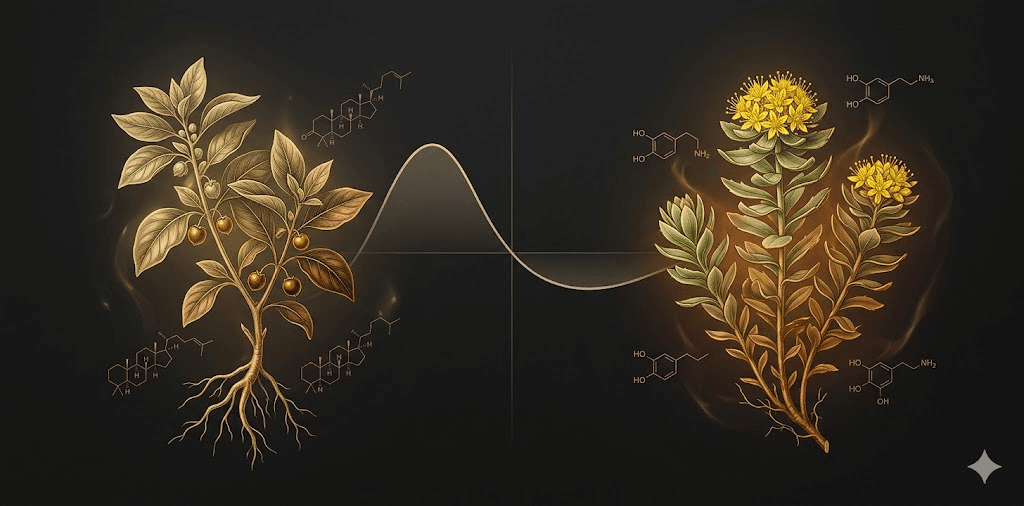
Lab finding — week 10 of Lua Labs Sub-topic L2.6. Closes the L2 line on the hypothalamic-pituitary-adrenal axis and its interaction with the ovarian cycle.
Sofía is 29 and has two supplements in her medicine cabinet
Her friend told her about ashwagandha. "It changed my life, I sleep better, I don't wake up at 3am anymore." Sofía bought it. Three weeks later: nothing. More tired, if anything. Her other friend, instead, had recommended rhodiola: "it worked for my brain fog, I have energy in the morning now". She decided to try it. One week: new anxiety, sleep-onset insomnia she did not have before.
Sofía does not know what to do. Neither does her friend. Neither does the influencer who recommended them.
What is missing from this conversation is a distinction almost no one makes: adaptogens are not interchangeable. Each one acts through a specific molecular pathway, on a specific state of the stress axis. And "ashwagandha vs rhodiola" is not a matter of preference — it is a choice that depends on what your daytime cortisol looks like today.
The claim marketing repeats and the evidence does not support
When you search for adaptogens on Google, the first idea that appears is that they "adapt to what your body needs". That they raise cortisol when it is low and lower it when it is high. That they normalize the stress axis in any direction.
This concept comes from the formal criterion of Brekhman and Dardymov in 1969: "normalizing effect regardless of the direction of the dysfunction". It is elegant. And it does not hold up when you confront it with clinical trials from the last ten years.
No human RCT of ashwagandha shows that it raises cortisol when it is low. The foundational RCT (Chandrasekhar 2012, KSM-66 300mg bid × 60 days, n=64) measured a 27.9% reduction in serum cortisol in adults with subjective stress — all patients with an activated axis. The perimenopause RCT (Gopal 2021, n=100, 8 weeks) measured hormonal improvement (↑estradiol, ↑progesterone, ↓FSH, ↓LH) and reduction in hot flashes — but did not measure cortisol. The menopause RCT (Vani 2025, n=60) replicated the hormonal pattern.
What these studies show is clear: ashwagandha works by lowering elevated cortisol. The opposite directionality — raising collapsed cortisol — has no evidence.
This matters because it means ashwagandha is not a universal tool. It is a directional tool. And choosing it without understanding the direction of the problem is why so many women report that "it did nothing for me".
The piece that changes everything: two daytime cortisol phenotypes
In the report from three days ago, we described the two daytime cortisol phenotypes the literature distinguishes in perimenopause:
Phenotype A — Hyperreactive HPA. High morning cortisol, elevated cortisol awakening response (CAR), sleep-onset insomnia or 3am awakenings with a racing mind, anxiety, morning hot flashes. The stress axis is overactivated.
Phenotype B — Collapsed Allostatic Load. Low morning cortisol, flat or inverted CAR, sustained fatigue that does not improve with coffee, brain fog, difficulty getting the day started, diffuse hot flashes without a clear pattern. The stress axis is collapsed in its amplitude.
Both can coexist with the same age, the same amount of "objective stress", the same "normal" hormone panel. They are different phenotypes of the same axis. And adaptogens respond to them differently.
Ashwagandha: the adaptogen for Phenotype A
The main active compound in KSM-66 extract is withaferin A and other withanolides. Its molecular mechanism has three layers worth understanding:
First layer — NF-κB inhibition. Withanolides inhibit NF-κB through a bond with cysteine 38 of its p65 subunit. NF-κB is the transcription factor that, under inflammatory stress (including LPS from a gut with dysbiosis), activates CRH production in the hypothalamus. Less NF-κB → less CRH → less ACTH → less cortisol. It is a pathway that acts upstream of the axis.
Second layer — selective modulation of the glucocorticoid receptor (GR). Withaferin A binds covalently to the GR at its C-terminal domain and acts as a selective modulator (SGRM, Food Chem Toxicol 2023). Instead of activating all GR functions, it selectively activates the transrepression branch (anti-inflammatory) without generating the catabolic effects of a full glucocorticoid. This matters: it means ashwagandha partially mimics cortisol's anti-inflammatory action, which reduces the axis's demand on the adrenal.
Third layer — interaction with Hsp90 and FKBP51. Withaferin A binds to the C-terminus of Hsp90, the chaperone that keeps the GR inactive together with FKBP51 (the protein we documented in the progesterone vs cortisol report as a mediator of "functional progesterone withdrawal"). By inhibiting Hsp90, withaferin A potentially displaces FKBP51 from the complex — which could simultaneously restore progesterone receptor sensitivity in the corpus luteum. This last step is a coherent extrapolation, but it has not been directly proven in human ovarian tissue.
For a woman with Phenotype A, this chain of mechanisms is exactly what is needed: reducing axis activation from multiple points without collapsing the immune response or emptying available cortisol. The clinical evidence agrees: the Chandrasekhar RCT showed reductions in PSS and DASS, not only cortisol. In other words, patients felt better — not only biochemically, but also symptomatically.
For a woman with Phenotype B, this same chain does not help. Further reducing cortisol that is already collapsed, or "slowing down" an axis that already has low amplitude, may cause sedation, more fatigue, or nothing. The Gopal perimenopause RCT did not stratify by baseline HPA phenotype — we do not know how many of its responders had high vs flat CAR at the beginning. That is an important limitation the literature has not yet resolved.
Rhodiola: the adaptogen with the opposite mechanism
Rhodiola rosea acts through a completely different pathway. Its active compounds — salidroside (a phenylethanoid glycoside) and rosavins (phenylpropanoids unique to the species R. rosea, an authenticity criterion) — operate at another level of the system.
Salidroside selectively inhibits monoamine oxidase B (MAO-B). MAO-B is the enzyme that degrades dopamine in prefrontal and striatal circuits. By inhibiting it, salidroside increases dopaminergic availability. And here is the bridge with the stress axis: dopamine in the paraventricular nucleus of the hypothalamus inhibits CRH production. In other words, rhodiola does not lower cortisol "from below" (like ashwagandha via NF-κB) — it does it through a dopaminergic pathway that also restores energy, motivation, and focus.
Rosavins inhibit JNK (c-Jun N-terminal kinase), one of the kinases activated by oxidative stress. JNK contributes to FKBP51 induction — the same protein that appears with ashwagandha through another pathway. It is an interesting convergence: two adaptogens targeting FKBP51 through different mechanisms.
The strongest RCT (Olsson 2009, SHR-5 576 mg/day × 28 days, n=60) was in patients with stress-related fatigue syndrome — burnout. It showed a significant reduction in salivary cortisol in the awakening response (CAR), improvement in MADRS (depression), Pines (burnout), CCPT-II (concentration). The important detail: patients with fatigue syndrome are typically in transition or already in Phenotype B. The reduction in CAR can be interpreted as normalization if CAR was still elevated at the beginning, or as modulation if it was already collapsing.
The documented clinical pattern (not from RCTs, but from series and the bibliography of Panossian, Seely, and Abascal) is consistent: rhodiola is a stimulating adaptogen that restores rhythmic amplitude. It works better in women with sustained fatigue and brain fog — Phenotype B. In women with Phenotype A (sleep-onset insomnia, active anxiety), rhodiola may worsen the picture because its dopaminergic effects amplify activation that is already excessive.
The falsifiable hypothesis this generates
If this mechanistic reading is correct, it should be able to predict things. What we would expect to see in a properly stratified study is the following:
In Phenotype A (elevated CAR at baseline):
- Ashwagandha (KSM-66 + Holixer or another standardized extract) → significant reduction in PSS, improvement in sleep onset, improvement in the DHEA-S:cortisol ratio
- Rhodiola at a standard dose → worsening of sleep in a non-trivial proportion
In Phenotype B (flat or inverted CAR at baseline):
- Rhodiola (SHR-5 + possible Schisandra) → restoration of CAR amplitude, improvement in morning fatigue, improvement in focus
- Ashwagandha alone → neutral response or additional sedation, with no improvement in amplitude
This prediction can be falsified. If an RCT stratified by CPC (Cortisol Phenotype Classifier) shows that responders are randomly distributed across phenotypes, the hypothesis loses strength. As far as the literature has gone, no published clinical trial has stratified participants by baseline cortisol phenotype before assigning adaptogens. It is a methodological gap Lua Care is being designed to help close in the future, once we have enough longitudinal data to collaborate with academic research.
The right question before buying anything
If you made it this far, the practical conclusion is this: before buying an adaptogen, the question is not "which brand has the best review"; it is "what is my daytime cortisol phenotype".
That question is not answered with an isolated morning cortisol test. It is answered by looking at the shape of the curve — awakening peak, midday, afternoon, night — and crossing it with your real symptoms: how you wake up, when fatigue arrives, what pattern your sleep has, what triggers your hot flashes. There are ways to do it with saliva (4-point kits) and ways to approximate it digitally without saliva. Lua Care is being designed to do it the second way: estimating a digital phenotype from patterns you already track.
What is clear today, with the available literature:
- "Ashwagandha is good for stress" is imprecise. Ashwagandha is good for stress with activated cortisol — Phenotype A.
- "Rhodiola gives you energy" is imprecise. Rhodiola restores amplitude when amplitude is collapsed — Phenotype B.
- "Adaptogens adapt to what your body needs" is marketing. Each one has a specific directionality and a specific mechanism. Confusing them means confusing the questions.
Why this closes the L2 line
This report closes a series of six sub-topics on the hypothalamic-pituitary-adrenal axis and its interaction with the ovarian cycle. What began with gut bacteria and progesterone and continued through gut-brain-ovary axis, chronic stress disrupts the menstrual cycle, moderate stress and the ovarian CRH paradox, progesterone vs cortisol at the glucocorticoid receptor, two cortisol biotypes, and allostatic load, ends with the practical answer the literature allows today: the state of the stress axis is heterogeneous, and the tools (including adaptogens) are not universal. Recognizing the cortisol phenotype before acting is the shift missing from much of hormonal health marketing.
The next line (L3) enters the thyroid axis and its role as a global modulator of the cycle. But that is another story.
Lua Labs does not recommend doses, brands, or protocols. What we publish here is a translation of scientific literature so you can make informed decisions with a health professional who knows you. If you are considering an adaptogen, that conversation belongs with your trusted gynecologist, endocrinologist, or integrative physician.
Key references from the full report:
- Chandrasekhar K et al. (2012). Indian J Psychol Med, 34(3):255-262. PMID: 23439798.
- Gopal S et al. (2021). J Obstet Gynaecol Res, 47(12):4414-4425. DOI: 10.1111/jog.15030
- Vani I et al. (2025). Front Reprod Health, 7:1647721.
- Olsson EMG, von Schéele B, Panossian AG. (2009). Planta Med, 75(2):105-12. PMID: 19016404.
- Panossian A et al. (2016). Phytomedicine. PMC4727095.
- Withaferin A SGRM (2023). Food Chem Toxicol. DOI: 10.1016/j.fct.2023.113836
- Lopresti AL et al. (2022). PMC9524226 (Holy Basil RCT).