You were told your anti-TPO antibodies "are high but do not matter" because your TSH looks fine. You were told it is something women have, something that will probably never cause problems. You were told that if problems do appear, there is levothyroxine.
And still, something does not quite add up. Your AMH dropped faster than seems reasonable for your age. Or you had an unexplained early loss and, when looking at the immune panel, anti-TPO came back positive. Or you were told your ovarian reserve is diminished without a clear cause, and when reviewing the history, those antibodies have been circulating for years.
The conclusion that "anti-TPO with normal TSH does not matter" comes from a serious trial — T4LIFE, published in NEJM in 2022. But the full reading of that trial, together with three papers around it, tells a different story. One where the problem was not whether it mattered or not, but that we were measuring the wrong node.
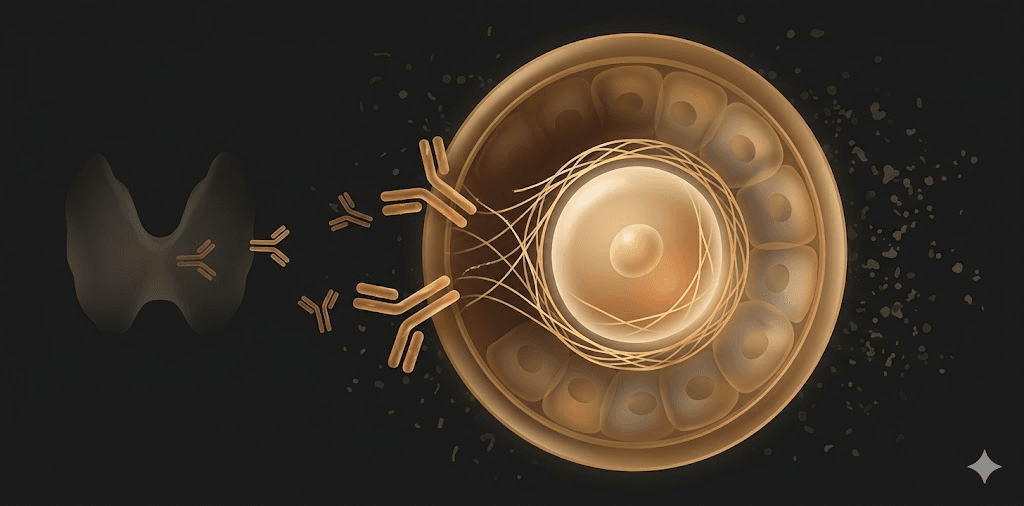
The egg and the thyroid share a protein structure
In 2005, Kelkar and colleagues (J Reprod Immunol) took sera from 82 women with premature ovarian failure and tested them against the zona pellucida of the human egg, against the thyroid, and against a series of control tissues: uterus, spleen, kidney, liver, adrenal, pancreas, pituitary.
The antibodies cross-reacted with thyroid and with zona pellucida — specifically with ZP3, the dominant glycoprotein of that layer. They did not cross-react with any other tissue.
That indicates something concrete: there is enough structural homology between TPO and ZP3 epitopes for an immune system that learned to recognize one to end up reacting against the other. This is not a statistical association — it is molecular mimicry measured in the lab.
ZP3 is around every egg. Not around the corpus luteum, not in the endometrium. In the egg itself. If your antibodies cross-react with ZP3, what is being damaged is inside the follicle, before ovulation.
The follicle breaks from within
Bagheri and colleagues (BMC Immunology 2023) took women with recurrent pregnancy loss and separated the anti-TPO positive from the anti-TPO negative. They measured Th17 and Treg cytokines and the transcription factors that regulate them.
In the anti-TPO-positive women, they found: reduced TGFβ, reduced Foxp3, elevated RORγT, elevated IL-17.
That signature is not ambiguous. Foxp3 is the transcription factor of Tregs, the regulatory T cells that maintain tolerance. When they go down, the immune system's ability to "not attack itself" goes down. RORγT is the master factor of Th17, a pro-inflammatory population. When it goes up, the tissue environment becomes hostile. Elevated IL-17 in follicular fluid means the cells developing alongside the egg are in an environment of active inflammation.
Granulosa — the cells that surround the developing egg, the ones that produce estrogen, the ones that support the dominant follicle — responds to that environment. There is emerging literature on increased apoptosis in granulosa under Th17 pressure, mediated by complement C3a/C5a, which couples to receptors expressed by granulosa.
The damage is not in the thyroid. It is in the follicle.
Ovarian reserve drops ahead of time, and not by small amounts
Up to this point, you could think: "mechanically interesting, but clinically, how much does it change?".
Arlıer and Kükrer published in J Clin Med in 2025 the analysis of 1,460 euthyroid infertile women — all with normal TSH, all evaluated in a fertility clinic. They compared AMH between anti-TPO-positive and anti-TPO-negative women.
Anti-TPO negative: AMH 3.33 ± 3.03 ng/mL.
Anti-TPO positive: AMH 1.47 ± 1.52 ng/mL.
More than twice the difference. The effect was stronger in women younger than 35 years, non-obese, without polycystic ovary syndrome — that is, in the women where there was no other reasonable reason to expect low reserve.
And Hsiao and colleagues (2021, Human Reproduction, Taiwan national cohort of 21,325 women with 12 years of follow-up) confirmed the pattern at epidemiological scale: women with Hashimoto's have 2.4 times higher risk of infertility due to ovarian failure than matched controls.
This is not statistical noise. It is a large, consistent signal across multiple cohorts, with a molecular mechanism behind it.
So why did T4LIFE conclude that treatment was not needed?
T4LIFE (Korevaar and colleagues, NEJM 2022, n=368) randomized euthyroid anti-TPO-positive women with recurrent loss to levothyroxine vs placebo. There was no difference in live births. The public interpretation of the trial became "anti-TPO with normal TSH does not matter, do not treat".
But T4LIFE only tested one very specific hypothesis: that the problem was thyroid-hormonal. That if you gave levothyroxine, the woman would do better.
If the real mechanism is what Kelkar, Bagheri and Arlıer documented — molecular mimicry with ZP3, Th17 polarization, immune-mediated damage to granulosa — levothyroxine was never going to correct it. Thyroid hormone does not turn off cross-reactive antibodies. It does not reverse a Treg/Th17 imbalance. It does not protect granulosa from activated complement.
The trial did not fail because anti-TPO did not matter. The trial answered, clearly, that thyroid hormone alone is not the right lever. What remains valid — and urgent — is asking which one is.
What this means for Latin America
Almost all the literature I cited was done in European, Asian and U.S. cohorts. The prevalence of anti-TPO in Mexican women, in cohorts with population-based sampling, is poorly characterized. Ocelo-Mora 2014 reported in women from Yucatán 14.4% positivity for anti-TPO or anti-Tg in non-pregnant women — consistent with the global average, but without stratification by ovarian reserve or fertility status.
Carrillo-Lozano and colleagues (2021) measured in 1,496 infertile Mexican women that 40.7% had subclinical hypothyroidism under the ASRM threshold (TSH >2.5 mUI/L). But that same work did not cross the data with anti-TPO. It is a specific gap in the LATAM literature.
What we know today: if the prevalence of anti-TPO in Mexican women is similar to the global average (around 10-14%), and if the effect on AMH is of the order reported by Arlıer in 2025, there is a substantial group of women with diminished ovarian reserve ahead of time, without an obvious clinical cause identified, where the missing piece is thyroid autoimmunity that was dismissed as "not relevant".
What this changes for one specific woman
If you have positive anti-TPO with normal TSH, there are three questions worth having answered — regardless of what you were told by a doctor who has not read this literature:
-
What is your current AMH, not just your TSH? AMH reflects ovarian reserve directly, and it is where the anti-TPO signal is seen. If you have never measured it and you have positive anti-TPO, this is the key question.
-
Are other autoimmunities involved? POI with thyroid autoimmunity very frequently coexists with celiac autoimmunity, direct ovarian autoimmunity (anti-StCA, anti-NALP5), autoimmune adrenal insufficiency. Sullivan and colleagues (JCEM 2024) made it clear: when POI appears, the question is not only about the ovary.
-
Are you tracking time well? The decline in ovarian reserve is not abrupt — it is gradual. What women usually report first is subtle cycle shortening (from 28-29 to 25-26 days), changed hormonal response, perimenopausal symptoms ten years earlier than expected. If you keep a real cycle-by-cycle record, that slope becomes visible.
Lua Care does not make the diagnosis. What it does is capture the pattern. And the pattern is what you bring to the consultation when you ask — not for "a TSH to rule out thyroid" — but for the profile the mechanism justifies: TSH, free T4, free T3, anti-TPO, anti-Tg, AMH, antral follicle count by ultrasound.
We have spent months building a small digital lab inside Lua where every week we read what is being published in reproductive endocrinology and cross it with the longitudinal data users are generating. The idea is not to write the next paper. The idea is that when something concrete changes the clinical conversation — like the model Kelkar, Bagheri and Arlıer are building — the woman living the symptom is the first to know, not the last.
When a clinical guideline takes ten years to update, women lose those ten years.
Lua Care is a longitudinal hormonal intelligence app made in Mexico for women in LATAM. It learns with you, observes real patterns by cycle, and helps you bring the right questions to the person who can answer them.
Medical disclaimer: This article is educational and does not constitute a diagnosis or clinical recommendation. If you have positive anti-TPO, diminished ovarian reserve or recurrent pregnancy loss, consult a reproductive endocrinologist. Lua Care does not diagnose disease or replace medical consultation.