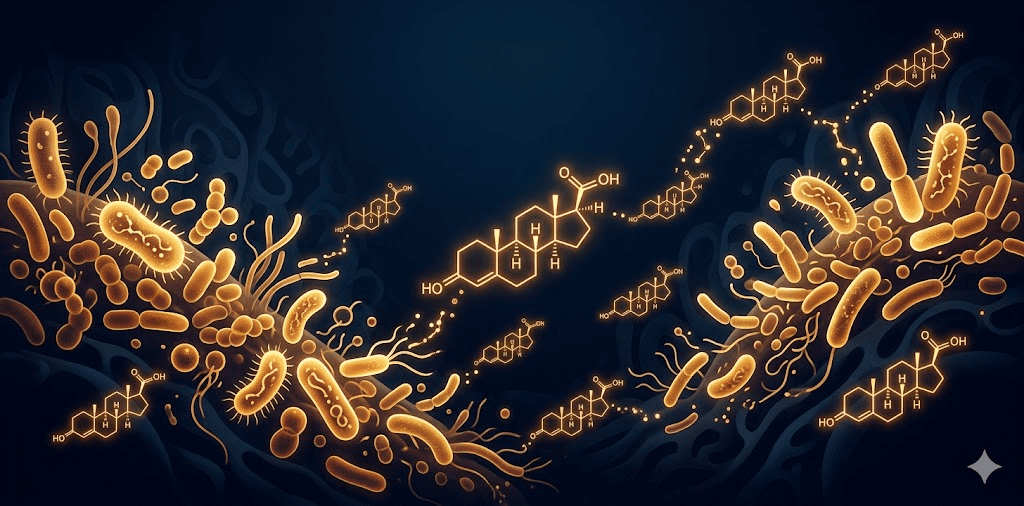
When we talk about progesterone, everyone thinks of the ovaries. Specifically, the corpus luteum —the structure that forms after ovulation and produces progesterone during the luteal phase of the cycle.
But there is a chapter of hormonal endocrinology that is only just being written. And it begins in an unexpected place: your gut.
We already knew the estrobolome. Now there is a progesterobolome.
In 2011, hormonal microbiology coined the term estrobolome: the set of bacterial genes capable of metabolizing estrogens. The star enzyme was microbial β-glucuronidase (gmGUS), expressed in ~60 bacterial genera, which deconjugates estrogenic glucuronides excreted in bile and allows estradiol and estrone to return to circulation. Up to 65% of biliary estradiol can be recycled through this pathway.
What had not yet been conceptualized was an analogous system for progesterone. And that is exactly what the 2022-2024 literature is consolidating.
In 2022, a study published in Frontiers in Microbiology (Wang et al.) proposed a "progesterobolome" for the first time. Working with a porcine model of gestation, the team showed that when vancomycin was administered —an antibiotic that reduces Parabacteroides, among others— fecal excretion of allopregnanolone-sulfate and pregnanolone-sulfate increased significantly, while serum levels remained relatively stable. The interpretation: gut bacteria normally deconjugate these sulfates to allow enterohepatic reabsorption. When those bacteria fall, the sulfates are lost in stool and recycling breaks down.
The chemical difference from the estrobolome is important. Progesterone metabolites excreted in bile are sulfated (not glucuronidated). Deconjugation requires microbial sulfatases, an enzymatic capacity much more restricted than β-glucuronidase. The genus Parabacteroides is one of the few that encodes a full arsenal: at least 19 sulfatases plus the anSME gene that activates them under anaerobic conditions.
The 2024 discovery that rewrote everything
Up to this point, we had a passive recycling system: the gut returns to circulation what was already there. But in 2024, a paper published in Cell —one of the most cited of the year in endocrinology— showed something that changes the conversation.
Emily Balskus's lab at Harvard showed that two human gut bacteria, Eggerthella lenta and Gordonibacter pamelaeae (both from the Coriobacteriaceae family), perform an unexpected chemical reaction: 21-dehydroxylation of glucocorticoids. In plain terms: they convert biliary cortisol and cortisone into pregnenolone, progesterone and allopregnanolone.
In other words: these bacteria take the stress hormone and convert it into the quintessential anxiolytic hormone.
There are details worth understanding:
- The reaction requires hydrogen gas (H₂) as an electron donor. That H₂ is produced by other gut bacteria (notably E. coli). In other words, it is a cooperative process across multiple species.
- The responsible gene cluster was identified: Elen_2451-2454, which encodes a molybdenum-dependent oxidoreductase and an Fe-S protein.
- Women in the third trimester of pregnancy have fecal allopregnanolone levels 100 times higher than non-pregnant women, directly correlating with the abundance of these taxa.
Why does this matter? Allopregnanolone is the active ingredient in brexanolone (Zulresso®), a medication approved by the FDA for postpartum depression. It is one of the most potent known positive modulators of the GABA-A receptor: anxiolytic, sedative and anticonvulsant.
The fact that part of our allopregnanolone is produced in the gut, from cortisol, opens a huge question: how much of the calm we feel —or its absence— depends on the state of our microbiome?
Two intestinal pathways, one dysbiosis
To summarize what the 2022-2025 evidence suggests:
- Parabacteroides pathway — deconjugates biliary progesterone sulfates (PM4S, PM5S) and allows them to return to circulation.
- Eggerthella + Gordonibacter pathway — converts biliary cortisol directly into pregnenolone, progesterone and allopregnanolone.
A woman with perimenopausal dysbiosis —a drop in Lactobacillus, Bifidobacterium, Roseburia and Parabacteroides, along with an increase in Enterobacter and other pro-inflammatory taxa— loses both pathways at the same time. Recycling falls, cortisol→progesterone conversion falls, and a characteristic symptomatic profile emerges: luteal anxiety, insomnia, cyclical irritability, the feeling of "not being able to handle what I used to handle."
What the literature has not yet quantified well is what proportion of the perimenopausal drop in progesterone is explained by ovarian dysfunction and what proportion by intestinal dysfunction. But the fact that there is a measurable —and potentially modulable— intestinal component is a paradigm shift for understanding what many women experience between ages 40 and 55.
The bridge with chronic stress
There is one more connection, still speculative but biologically plausible.
Biliary cortisol is the substrate for intestinal progesterone production. In other words, chronic stress "feeds" this system —but only if the microbiome is intact. When dysbiosis sets in, biliary cortisol still reaches the gut, but it is no longer converted. It remains systemically active, without being buffered by conversion into allopregnanolone.
This modifies a classic idea in endocrinology: it is not just that "cortisol competes with progesterone for the glucocorticoid receptor." It is that cortisol could, under conditions of a healthy microbiome, be partially converted into progesterone and become part of its own antidote. When the system fails, stress is left without an endogenous brake.
It is a hypothesis that requires human validation. But it is coherent with everything we know today about the gut-brain-hormone connection.
What you can observe
This research does not (yet) allow firm individual recommendations. What it does allow is observing early signals that previously had no framework for interpretation:
- Antibiotic history: multiple courses of broad-spectrum antibiotics over a lifetime are a plausible risk factor for a more symptomatic perimenopause. Cumulative load matters.
- Bowel movement pattern: slow transit + chronic constipation increase the reabsorption of poorly processed hormones and reduce functional bacterial contact time.
- Dietary diversity: diverse fermentable fiber (legumes, vegetables, whole grains, fruits with skin) supports genera with active sulfatases. Monotonous diets, even when "healthy," reduce diversity.
- Regional fermented foods: the traditional Latin American diet —beans, nixtamalized corn, nopal, artisanal fermented foods— probably supports the progesterobolome better than ultra-processed diets. This has not been characterized in the literature. It is a specifically Latin American research gap.
- Luteal symptom severity: tracking the difference between how you feel in the follicular phase (days 1-14) and in the luteal phase (days 15-28) gives you a proxy for how much your progesterone is fluctuating —and how much endogenous buffer you have.
What Lua observes
At Lua, we do not propose supplements or specific interventions. What we do is observe longitudinal correlations between your food, your symptoms and your cycle over months. Variables that seem to be indirectly capturing the progesterobolome:
- Weekly fermentable fiber diversity
- Regional fermented food intake
- Bowel movement frequency and consistency
- Luteal vs follicular symptom severity
- History of antibiotic use (a new variable we are incorporating)
With 60-90 days of longitudinal data, individual patterns begin to emerge that no single biomarker can capture. We do not tell you what to do. We help you see what happens in your body when you do something.
Scientific references
- Wang P, Chen Q, Yuan P, et al. (2022). "Gut microbiota involved in desulfation of sulfated progesterone metabolites: A potential regulation pathway of maternal bile acid homeostasis during pregnancy." Frontiers in Microbiology, 13:1023623.
- Ly LK, Krieger-Burke T, Mahmud Y, Wong M, Devlin AS (2024). "Gut bacteria convert glucocorticoids into progestins in the presence of hydrogen gas." Cell, 187(13):3344-3358.
- Liu Y, Liu C, Wu Y, et al. (2025). "Parabacteroides as a promising target for disease intervention: current stage and pending issues." npj Biofilms and Microbiomes, 11:135.
- Duan R, Guan X, Huang K, et al. (2024). "Therapeutic potential of Parabacteroides distasonis in gastrointestinal and hepatic disease." MedComm, 5(12):e70017.
- Wang K, Liao M, Zhou N, et al. (2019). "Parabacteroides distasonis Alleviates Obesity and Metabolic Dysfunctions via Production of Succinate and Secondary Bile Acids." Cell Reports, 26(1):222-235.
This article is informational. It does not constitute medical advice or a treatment recommendation. If you have significant perimenopausal symptoms, consult a healthcare professional.