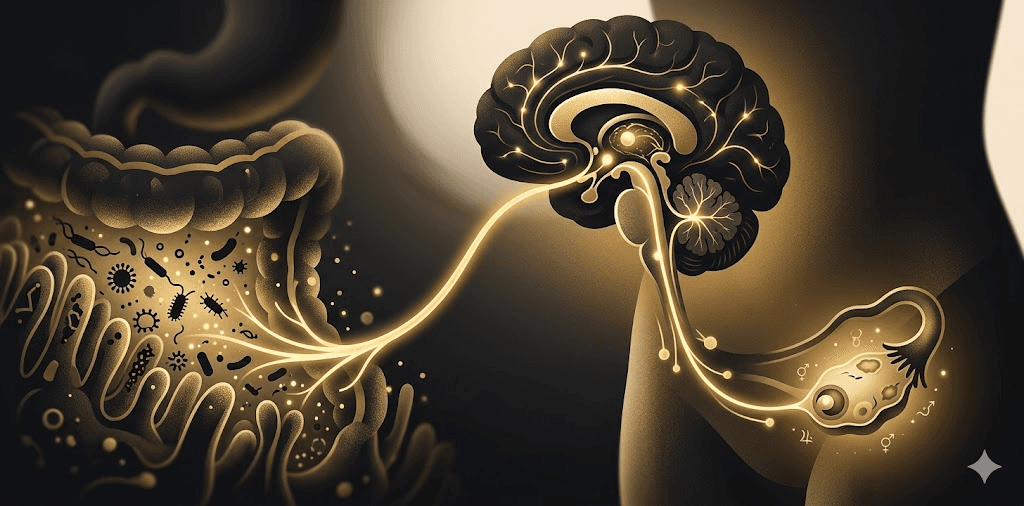
When a woman enters perimenopause, the first symptoms are almost never hot flashes. They are anxiety without a clear cause, fragmented sleep, brain fog that was not there the year before. Hormone labs often come back "normal." And the usual medical response is: it is age, it is stress, it is anxiety.
The science of the last five years is showing something else. What is failing, in many cases, is not a hormone. It is a cable.
The cable that connects the gut to the brain, and from there to the ovaries, is the vagus nerve — the tenth cranial nerve, the longest nerve in the autonomic nervous system. 80% of its fibers are afferent, meaning they carry information from the gut to the brain, not the other way around. The brain is more interested in listening to the gut than in giving it orders.
And in perimenopause, that line of communication starts to fail.
The triple arrow: gut-brain-ovary
The system works like this. Gut bacteria produce three types of signals that reach the brain:
1. Short-chain fatty acids (SCFAs). Butyrate, propionate, and acetate are produced by bacteria such as Faecalibacterium, Roseburia, Bacteroides, and Prevotella from fiber fermentation. They activate GPR41 and GPR43 receptors in enteroendocrine cells (L and K cells), which release PYY and GLP-1. These hormones activate afferent vagal terminals in the lamina propria.
2. Enterochromaffin serotonin. 95% of the body's serotonin is synthesized in the gut, in cells called enterochromaffin cells, through the enzyme TpH1. These cells are the main chemical sensors of the digestive tract: they detect dietary tryptophan, SCFAs, bile acids, and bacterial metabolites. The serotonin they release does not enter the lumen — it is released basolaterally, directly onto vagus nerve terminals, activating 5-HT3 receptors.
3. Bacterial neurotransmitters. Lactobacillus brevis, L. plantarum, and Bifidobacterium dentium produce GABA through bacterial glutamate decarboxylase. Lactobacillus reuteri produces histamine. Bacillus produces dopamine. These do not cross the blood-brain barrier intact, but they modulate enteric inhibitory tone and the excitability of local vagal terminals.
All this information travels through the vagus nerve to the nodose ganglion, ascends to the nucleus of the solitary tract in the medulla oblongata, and from there is distributed to the hypothalamus: to the paraventricular nucleus (where the stress-related CRH neurons are), to the arcuate nucleus (where the kisspeptin neurons that generate GnRH pulses are), and to the preoptic area (where the GnRH neuronal cell bodies are).
In other words: what your gut tells your brain simultaneously modulates hunger, stress, and reproduction. With a single cable.
The ovary also listens to the vagus
Until recently, it was assumed that the ovary only received endocrine signals: FSH and LH from the pituitary. Recent evidence changed that.
Du et al. published a review in 2023 in Frontiers in Endocrinology on the role of the autonomic nervous system in polycystic ovary syndrome. Citing experiments in rats with induced PCOS: vagotomy — cutting the vagus nerve — restores cyclicity, induces ovulation, reduces ovarian androgens, and decreases intraovarian norepinephrine. The effect is asymmetric: left vagotomy has different effects than right vagotomy, because the left and right ovaries are innervated differently.
Morales-Ledesma and collaborators showed in 2020 that vagotomy alters both hypothalamic GnRH secretion and direct ovarian steroidogenesis. The ovary expresses choline acetyltransferase (ChAT) and muscarinic receptors. Vagal acetylcholine modulates the production of steroid hormones in theca and granulosa cells without going through gonadotropins.
The brain speaks to the ovary through two cables: the classic endocrine one (GnRH → LH/FSH → ovary) and the direct neural one (vagus → ovary). The naive hypothesis of the HPO axis as a purely neuroendocrine circuit was incomplete.
Propionate crosses the blood-brain barrier
There is one bacterial metabolite that does enter the brain: propionate. Hoyles and collaborators (2018, cited and updated 2024-2025) showed that propionate crosses the blood-brain barrier through MCT1 and MCT2 transporters. Once inside, it activates FFAR3 receptors in the cerebral endothelium, reduces CD14 and TLR4 (the receptors that detect inflammatory bacterial lipopolysaccharide), and protects the tight junctions that keep the blood-brain barrier selective.
Wenzel et al. in 2024, published in ACS Chemical Neuroscience, showed that propionate suppresses pro-inflammatory microglial activation — microglia are the immune cells of the brain, and in perimenopause they become overactivated, generating what is called hypothalamic neuroinflammation.
This matters because hypothalamic microglial activation explains part of the vasomotor symptoms (hot flashes) that the drop in estrogen alone does not explain. Woman with perimenopausal dysbiosis = low propionate = more permeable blood-brain barrier = hyperactivated microglia = hypothalamic neuroinflammation.
Why anxiety arrives before hot flashes
Cantu-Jungles and Hamaker published in 2026 in Nutrients (PMC12986310) an exhaustive review on the microbiota in perimenopausal anxiety. Their model, which synthesizes dozens of studies, proposes that the perimenopausal transition is characterized by:
- Reduced microbial diversity
- Depletion of Lactobacillus, Bifidobacterium, and SCFA producers
- Enrichment of pro-inflammatory signatures
The drop in estrogen directly modulates microbial composition — enterocytes have estrogen receptors that, when deactivated, alter the luminal environment and favor some bacteria over others.
The critical point is this: the bacteria that produce GABA are precisely the ones that fall first. Lactobacillus brevis, L. plantarum, Bifidobacterium dentium. Vagal signaling modulated by bacterial GABA decreases. Enterochromaffin cells, sensitized by SCFAs, reduce their serotonin production (germ-free reduces intestinal serotonin 60%). The cable weakens.
In parallel, the estrogen receptors in the nodose ganglion — the anatomical base of the vagus nerve — reduce their excitability when E2 falls. Vagal afference not only receives less input from the gut; it also responds less to the input it does receive.
The result is what some researchers are starting to call the neurobolome: the sub-organ formed by neurotransmitter-producing microbiota + enterochromaffin cells + vagus nerve + hypothalamic nuclei, operating as one unit. When this sub-organ fails, the first symptoms are the ones that depend on vagal-GABA-serotonergic input to the brain: anxiety, insomnia, irritability. Hot flashes come later, when hypothalamic neuroinflammation consolidates.
The vagus also modulates GnRH pulses
Patel and Dhillo published a review in 2024 in Annals of the New York Academy of Sciences on kisspeptin in functional hypothalamic amenorrhea. Kisspeptin is the generator of GnRH pulses. Without kisspeptin pulses, there is no ovulation.
What they show is that KNDy neurons (kisspeptin-neurokinin B-dynorphin) in the arcuate nucleus do not respond only to leptin, ghrelin, or cortisol. They receive direct projections from the nucleus of the solitary tract, meaning from the receptor of vagal afferents.
This means: the state of the gut — satiety, inflammation, SCFAs, bacterial GABA — adjusts the frequency of GnRH pulses without going through the classic metabolic hormones. A dysbiotic gut sends information that reduces kisspeptin activity → reduces GnRH pulse frequency → anovulatory cycles, short luteal phase, perimenopause that advances faster than "expected for age."
Implications for Lua Care
This is the sixth consecutive session of Lua's scientific lab dedicated to the L1 line — the gut-hormonal axis. With this report, the line closes.
What emerges from the six sessions is a unified model: estrobolome, progesterobolome, and neurobolome are three faces of the same organ, not separate entities. Female hormonal health depends on the integrity of a single system formed by microbiome + enteric epithelium + enterochromaffin cells + vagus + solitary nucleus + hypothalamus (KNDy + PVN + ARC) + ovary, operating bidirectionally through two parallel routes: the enterohepatic endocrine route and the direct vagal neural route.
What matters most for Lua is that this complete sub-organ can be captured with food logs and check-ins, without needing serum biomarkers. The components of vagal tone can be inferred from what the user already records:
- SCFA-producing foods (oats, lentils, green banana, nopal, black beans, nixtamal)
- Foods with GABA-producing bacteria (yogurt, kefir, jocoque, miso)
- Tryptophan-rich foods (turkey, seeds, dairy, banana)
- Sleep regularity (a direct proxy for nocturnal HRV)
- Alcohol load (chronic alcohol is vagal neuropathy)
Lua's conceptual model now includes, as of this session, a Vagal Tone Proxy Score (VTPS) — a five-component digital biomarker computable from the data we already capture. It is the first one from the lab that is a proxy for an integrated system, not an isolated mechanism.
The food formulation that synthesizes the close of L1 is what we provisionally call Vagal Estro-Buffer: nixtamalized tortilla + beans + nopal + a traditional LATAM fermented food + raspberry or pomegranate + adequate dietary tryptophan + breathing practice at 4-6 cycles per minute. It is not a recipe. It is a dietary and behavioral pattern that simultaneously touches the three faces of the hormonal sub-organ.
The question that opens the next chapter
If gut-brain-ovary is a system, then the next level of complexity is understanding how chronic stress — elevated cortisol, the hyperactive HPA axis — hijacks the reproductive system when this circuit is already compromised.
That is the L2 line the lab begins next week. But the conceptual loop is already pre-built. Cortisol is not only progesterone's enemy competing for its receptor; it is also a substrate of the progesterobolome, which converts it into intestinal progesterone. Vagal afference modulates CRH in the paraventricular nucleus before any cortisol → brain negative feedback occurs. And perimenopausal adrenal allostasis — that phase when the adrenal gland tries to compensate for the failing ovary — has a vagal-intestinal component that conventional medicine still does not incorporate.
The most interesting part of longitudinal hormonal intelligence — capturing every day what you eat, how you sleep, what you feel, for 90 days — is not seeing patterns we already know. It is detecting the correlations that classical physiology has not yet connected. The gut-brain-ovary axis is the first clear example of that.
This article is part of the Lua Care research lab, where each finding connects scientific literature with mechanistic hypotheses for future features and validation. It is not medical advice. If you have persistent perimenopausal symptoms, consult a healthcare professional.