You were told your thyroid is fine. You were told your progesterone "looks low but within what is expected." You were told early losses are "one in four" and that next time will probably be different.
And still, there you are. With a luteal phase that lasts nine days instead of twelve. With cold that the other women in the waiting room do not feel. With results that look normal on paper and a body that does not behave as if they were.
You are not imagining it. Scientific literature from the last two years describes precisely why a "clean" thyroid panel can coexist with a failing corpus luteum. There is a pattern. And for a long time, it had not been named.
The corpus luteum is more fragile than classical endocrinology suggests
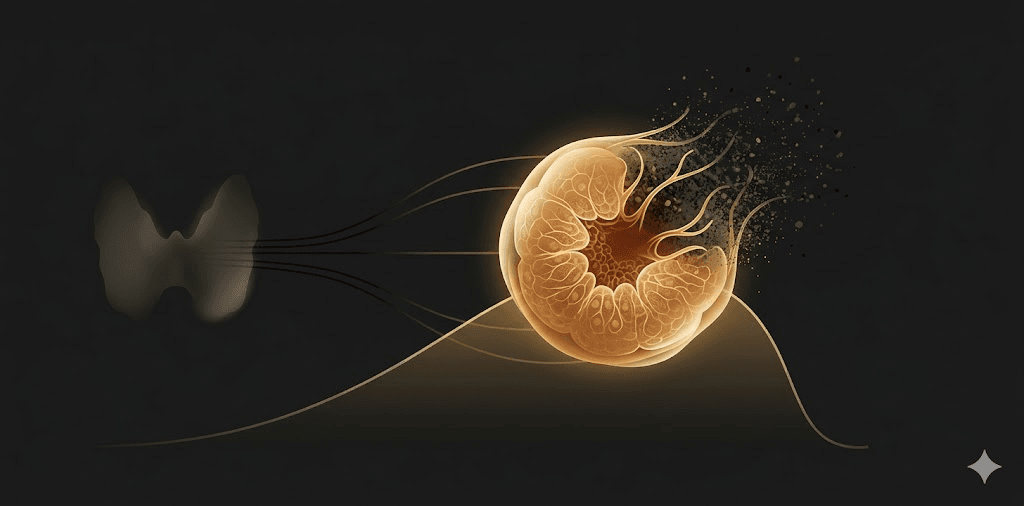
The corpus luteum is the structure that forms in the ovary after ovulation. Its job is to produce progesterone for about fourteen days, sustain the endometrium, and allow an embryo, if one arrives, to implant.
What textbooks teach: progesterone is synthesized from cholesterol, in a process that depends on several proteins — including StAR (which transports cholesterol into the mitochondria), CYP11A1, and HSD3β2 (which catalyze the following steps). What is almost never said: many of those proteins have thyroid hormone response elements in their promoters. In other words, T3 — the active thyroid hormone — directly regulates how much progesterone the corpus luteum can make.
When a woman has T3 in the lower quartile of "normal," each of those steps works below its potential. The result is a corpus luteum that produces progesterone suboptimally — between 20% and 35% below the expected value. Too subtle to detect in a single measurement, enough to shorten the luteal phase and compromise endometrial receptivity.
The finding that changes the model: elevated TSH does not stimulate the corpus luteum. It damages it.
Up to this point, the model remains intuitive: high TSH, low T3, less progesterone. But a study published in 2024 in the Journal of Endocrinological Investigation (PMID 38190029) delivers a counterintuitive result that changes the whole picture.
The researchers took human granulosa-lutein cells — the cells that form the corpus luteum — and stimulated them directly with TSH. First, they confirmed the obvious: the TSH receptor (TSHR) is present in the human corpus luteum. But when they activated it:
- Progesterone production did not increase.
- Expression of StAR, CYP11A1, or HSD3β2 did not increase.
- It did induce dose-dependent cell death.
Put with the discomfort it deserves: chronically elevated TSH is not a passive marker of hypothyroidism. It is a signal that, at sufficient concentrations, kills corpus luteum cells.
This reverses the conceptual model. The chain is not "TSH does not stimulate progesterone, so progesterone drops." It is "elevated TSH degrades the structure that produces progesterone."
Five damage pathways converge into one condition
When each step is mapped, subclinical hypothyroidism is not a single trigger. It is the convergence of five mechanisms that amplify one another:
- Direct apoptosis. TSH activates the TSHR receptor in the corpus luteum → dose-dependent cell death (JEI 2024).
- Intracellular T3 deficiency. Low T3 → less active StAR, CYP11A1, and LDL receptor → less progesterone from the first cycle.
- Prolactin in the upper quartile. TRH, elevated as compensation, stimulates not only the thyroid, but also lactotrophs. Prolactin moves within the "normal" range, enough to partially suppress kisspeptin neurons in the hypothalamus and weaken the preovulatory LH surge. The follicle ovulates under-mature. The corpus luteum is already defective from the start.
- Autoimmune inflammation (when anti-TPO+ is present). Women with thyroid autoimmunity have increased uterine Th17/NK activation and reduced Treg. The endometrium becomes a hostile environment for the embryo, independent of TSH.
- The bridge with chronic cortisol. In women with a hyperreactive HPA axis, cortisol ubiquitinates (degrades) the DIO2 enzyme that activates T3 inside tissues. Tissue T3 falls even further, while blood tests continue to look normal.
The five pathways share one feature: none is detected by a single TSH measurement or by a standard thyroid panel taken on any random day.
The Latin American data is striking
Carrillo-Lozano and colleagues published a 2021 study (PMC8001256) of 1,496 infertile Mexican women. They found that the prevalence of subclinical hypothyroidism depends dramatically on the threshold used:
- TSH > 4.1 mUI/L → 14.7% of women.
- TSH > 2.5 mUI/L → 40.7% of women.
The difference — 25.9% — is the invisible population: declared euthyroid by their lab results, but whose biology, according to the mechanisms described above, is losing luteal function every cycle. And these are Mexican women, not a European or U.S. cohort. The region matters.
A second Mexican cohort, Velázquez-García 2025 (Cureus, n=222, public hospital in Tamaulipas), documented for the first time the natural history of subclinical hypothyroidism in LATAM: progression rates and predictive factors. It is the first longitudinal data on how this condition evolves in Latin American women.
The ASRM 2024 guideline and where the unresolved zone remains
The updated guideline from the American Society for Reproductive Medicine (ASRM 2024, DOI: 10.1016/j.fertnstert.2023.09.003) establishes three categories for women with fertility problems:
- TSH > 4.12 mUI/L → treat.
- TSH between 2.5 and 4.12 + anti-TPO+ → consider treatment.
- TSH between 2.5 and 4.12 without anti-TPO → "insufficient evidence."
That last category — "insufficient evidence" — is precisely the range where biology suggests that damage is happening. It is not that the evidence says "there is no effect"; it says "the clinical trials done so far did not stratify by the variables that matter" — the DIO2 Thr92Ala genetic variant, cortisol phenotype, selenium status, inflammatory load. Until those trials exist, it remains an individual clinical decision.
The detail in the T4LIFE trial that is often cited incorrectly
The T4LIFE trial (Korevaar 2022, Lancet Diabetes & Endocrinology, n=368) is the one usually cited as proof that "levothyroxine does not work" in women with recurrent pregnancy loss and anti-TPO+. But the nuance matters:
T4LIFE enrolled euthyroid women — with TSH within the normal range — who were anti-TPO positive. In that population, levothyroxine did not improve the live birth rate. But the mechanism of damage in euthyroid anti-TPO+ women does not run through low thyroid hormone. It runs through immune inflammation. Levothyroxine does not correct immunology.
For women with real subclinical hypothyroidism — TSH above the threshold, not euthyroid — the treatment question remains open and the biology still supports that treating makes sense. But no large trial has been done in that population after T4LIFE.
What a standard lab test does not capture, and what can be observed over time
A single TSH measurement is a snapshot of a moving system. What does count — and what no isolated lab test can see — is the pattern across several cycles:
- A luteal phase that progressively shortens (days between ovulation and the next period).
- Thyroid-like symptoms that appear in the second half of the cycle: more cold sensitivity, more late-afternoon tiredness, brain fog that was not there before ovulation.
- Cyclical hair shedding.
- Constipation that appears or worsens in the luteal phase.
- Repeated early losses (before weeks 8-10).
When this pattern is observed for three to six cycles, it is worth bringing it to a reproductive endocrinology consultation with a complete thyroid panel — not only TSH, but free T4, free T3, anti-TPO, anti-Tg. And, if possible, ideally measured at different moments of the cycle, not on a single day.
What we are building at Lua Labs
This article comes from the work of Lua Care’s internal digital laboratory. Every week, we cross recent scientific literature with mechanistic reasoning to map how female hormonal axes interact with each other — the gut axis, the stress axis, the thyroid axis. What we learn, we publish. And what we publish defines the features Lua gradually incorporates.
One of those features, currently in exploration, is what we call Luteal-Thyroid Coherence: a way to capture, across several cycles, the coherence (or loss of coherence) between the luteal phase and the digital thyroid profile. It is not a diagnosis. It is a pattern. And patterns are what 30-minute consultations cannot see.
If you work in endocrinology, reproductive medicine, or women’s health research and think we are reading the JEI 2024 paper incorrectly — write to us. The premise of Lua Labs is that open science wins faster when there is disagreement.
References:
- Anon (2024). "Role of thyroid stimulating hormone in the maintenance and functioning of the human corpus luteum." Journal of Endocrinological Investigation. DOI: 10.1007/s40618-023-02269-z. PMID: 38190029.
- ASRM Practice Committee (2024). "Subclinical hypothyroidism in the infertile female population: a guideline." Fertility and Sterility. DOI: 10.1016/j.fertnstert.2023.09.003.
- Carrillo-Lozano E et al. (2021). "Effect of the cut-off level for thyroid-stimulating hormone on the prevalence of subclinical hypothyroidism among infertile Mexican women." Diagnostics 11(3):426. PMC: 8001256.
- Velázquez-García JA et al. (2025). "Progression of subclinical hypothyroidism in a Mexican public hospital population." Cureus. DOI: 10.7759/cureus.82923. PMC: 12021256.
- Korevaar TIM et al. (2022). "Levothyroxine in euthyroid thyroid peroxidase antibody positive women with recurrent pregnancy loss (T4LIFE trial)." Lancet Diabetes & Endocrinology 10(5):322–329. PMID: 35298917.
- Wang Y et al. (2025). "Association of thyroid autoimmunity and pregnancy outcomes in unexplained recurrent pregnancy loss women." Frontiers in Endocrinology. DOI: 10.3389/fendo.2025.1711369. PMC: 12685602.
- Rashid MH et al. (2023). "The association of Treg and Th17 cells development factors and anti-TPO autoantibodies in patients with recurrent pregnancy loss." PMC: 10619307.
This article is informational and does not constitute medical advice. If you have symptoms or have experienced repeated pregnancy losses, consult a specialist in reproductive endocrinology or gynecology.