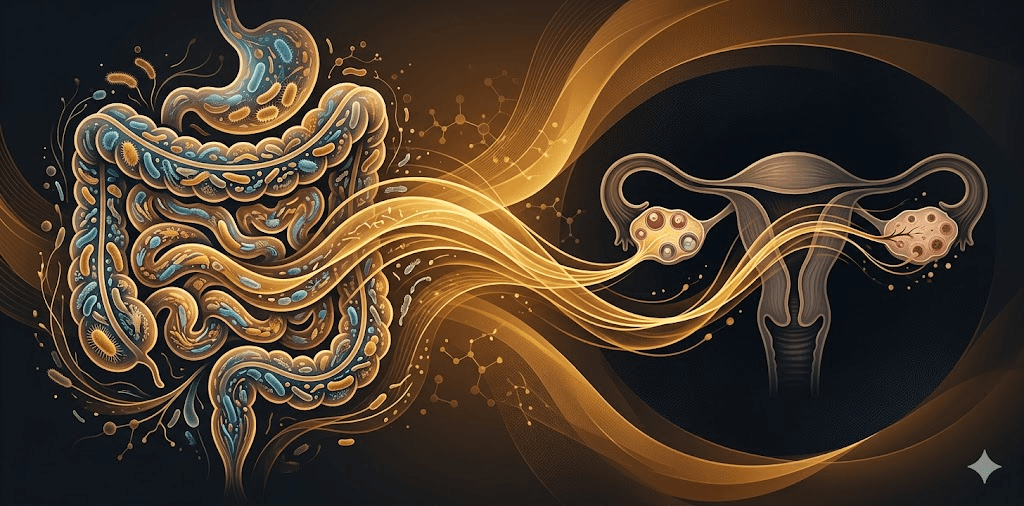
A year ago, saying that the gut microbiome affects the biological age of menopause would have sounded speculative. Not anymore.
Two studies published in the last twelve months — one in Cell Host & Microbe (2025) and another in Nature Aging (2026) — have moved the conversation from "the microbiome may modulate perimenopausal symptoms" to something deeper: the gut microbiome protects ovarian reserve itself. And the window in which this is decided may be much earlier than we thought.
The distinction many conversations still do not make
When we talk about "early menopause," we usually mix two very different things.
Biological menopause is a measurable phenomenon: how many ovarian follicles remain, how fast they are being depleted, how low AMH is (anti-Müllerian hormone, the most widely used biomarker for ovarian reserve), how elevated FSH is. If your AMH is 0.4 ng/mL at 38 years old, biologically you are close to ovarian failure regardless of how you feel.
Symptomatic menopause is subjective: severity of hot flashes, insomnia, cyclical anxiety, brain fog, mood changes, low libido. The Greene Climacteric Scale — the most widely used validated scale — tries to quantify it, but the experience is deeply individual.
These two dimensions do not always match. There are women with high FSH and mild symptoms. And women with barely elevated FSH and devastating symptoms. The clinical conversation often assumes both move in parallel. The 2025-2026 evidence suggests that the microbiome is, in part, what explains the dissociation.
The study that has made us think the most
The paper by Munyoki et al. 2025 (Cell Host & Microbe, DOI: 10.1016/j.chom.2025.09.006) ran an elegant experiment: comparing germ-free mice (raised in sterile conditions from birth, without a microbiome) with conventional mice.
What they found is striking:
- Germ-free mice produced half as many eggs across their lifespan.
- Their reproductive lifespan was half that of conventional mice.
- At birth, their ovarian reserve was similar to controls. But during postnatal development they showed excessive activation of primordial follicles, impaired follicular progression, and increased atresia.
That last point is the most important. It is not that germ-free mice were born with fewer follicles. It is that without a functional gut microbiome during a critical postnatal window, follicles activate and die at an abnormal speed. The pool of primordial follicles — which in mammals does not regenerate in adulthood — empties too early.
When researchers administered short-chain fatty acids (SCFAs) — the metabolites healthy gut bacteria produce when fermenting fiber — ovarian dysfunction was partially mitigated. This identifies a molecular mechanism: SCFAs produced by the gut microbiome are necessary signals for the normal development of ovarian follicular kinetics.
In accessible language: your ovarian reserve is not decided only by your genetics. It is also decided by what your gut microbiome did during the first years of your life.
The second discovery, even more counterintuitive
If Munyoki 2025 established the risk, Benayoun et al. 2026 (Nature Aging, DOI: 10.1038/s43587-026-01069-3) opened a door of hope. The team transplanted fecal microbiota from estropausal mice (analogous to postmenopause) into young mice with healthy ovaries. The result was counterintuitive: ovarian function in the recipient mice improved. 100% produced offspring, while a subgroup of controls failed.
How can that be explained? The authors' hypothesis: as ovaries age and respond less to hormonal signals, the microbiome evolves to compensate. It increases its ability to recycle estrogens via gmGUS, its metabolic signals adjust, and it becomes a kind of low-power but constant "second ovary." This adapted microbiome, when transplanted into a young animal, works like an amplifier.
What follows: not all women reach perimenopause with the same compensatory microbiome. Some have spent years with chronic dysbiosis — due to repeated antibiotics, low-fiber diets, chronic stress, sedentary behavior — and their gut never developed this compensatory phenotype. When the ovary begins to decline, there is no buffer. The hormonal drop is more abrupt, the symptoms more severe.
The first direct evidence in humans
The evidence in mice is suggestive, but not conclusive. What happens when we look at humans?
Luo et al. 2025 (EPMA Journal, DOI: 10.1007/s13167-025-00417-4) collected pelvic fluid samples from women with diminished ovarian reserve (DOR, AMH < 1.1 ng/mL) and compared them with controls. They performed 16S rRNA sequencing and found one genus clearly overrepresented in the DOR group: Capnocytophaga.
Capnocytophaga is a gram-negative bacterium that normally inhabits the oral cavity. Its elevated presence in the pelvic tract suggests disruption of mucosal barriers (intestinal, oral, vaginal) and bacterial migration. It is a genus with high LPS (lipopolysaccharide) activity — the endotoxin that activates TLR4 receptors in ovarian cells and induces local inflammation.
The predictive model combining Capnocytophaga + BMI showed an ability to estimate risk of diminished ovarian reserve. It is the first direct evidence, in humans, that a specific gut bacterium correlates with the biological biomarker (AMH), not only with symptoms.
The molecular mechanism is clarified in Huang et al. 2024 (Gut Microbes, DOI: 10.1080/19490976.2023.2295394): circulating LPS activates TLR4 in ovarian granulosa cells, which turns on the NF-κB pathway and releases IL-1β, TNF-α, and IFN-γ locally. This induces granulosa cell apoptosis and suppresses expression of CYP19A1 (aromatase), reducing estradiol production. The result: accelerated follicular atresia and an estrogen drop through two simultaneous fronts.
The full loop: why dysbiosis, stress, and menopause feed back into each other
When you put the three lines of evidence together — the estrobolome (the ability to recycle estrogens), the progesterobolome (the ability to recycle and produce progesterone from biliary cortisol), and this new mechanism of ovarian inflammation driven by LPS — a self-amplifying loop emerges:
-
Chronic dysbiosis → more LPS in circulation → ovarian inflammation → less estradiol and progesterone production → more follicular atresia.
-
Chronic dysbiosis → less Eggerthella/Gordonibacter → less conversion of biliary cortisol into progesterone → more active cortisol in circulation → more activation of the HPA axis (stress) → more dysbiosis.
-
Chronic dysbiosis → less enterohepatic recycling of E2 via the estrobolome → more abrupt hormonal drop → more severe symptoms.
The microbiome is not a side variable in the perimenopausal transition. It is one of the central nodes of the system.
What does this mean for a real woman today?
It is important to be careful. The strongest evidence still comes from animal models. Human studies are correlational, not causal. And specific probiotic interventions to improve human ovarian reserve are not clinically validated.
What the evidence does support, across multiple studies:
- Gut microbial diversity correlates with hormonal markers in perimenopausal women. Maintaining a diverse diet, rich in fermentable fiber and fermented foods, is the most robust intervention currently available.
- Repeated use of broad-spectrum antibiotics damages microbial diversity, possibly in a lasting way. The reasonable approach is to use them when they are necessary and not push for them when they are not.
- Chronic stress alters the intestinal barrier and favors metabolic endotoxemia (more circulating LPS). Stress management is not optional in hormonal health; it is biochemically central.
- If you were exposed to multiple courses of antibiotics before age 12, C-section, or no breastfeeding, that could have programmed a different setpoint in your follicular kinetics. It is not destiny, but it is context.
What Lua is trying to measure
At Lua we are building a system so women can observe, in their own bodies, how this biology moves in real time. What the literature describes as a population-level hypothesis, a woman can see as an individual pattern:
- How do your symptoms move when you increase dietary diversity?
- How does your energy or sleep change when you include more regular fermented foods?
- Is there a correlation between your cycle phase and the severity of your digestive symptoms?
- Does your previous antibiotic history correlate with how much luteal intensity you have?
These are questions the general literature will never be able to answer for you personally. That is what a longitudinal hormonal intelligence app can do, with your data, in your time window.
What we still do not know
It is honest to recognize the limits of this evidence:
- Extrapolating from germ-free mice to humans with partial dysbiosis is a major leap. The biology is not identical.
- There is no prospective human cohort with data on childhood microbial exposure + adult AMH. The association is plausible but not proven.
- The compensatory microbiome described by Benayoun 2026 has been demonstrated in mice, not humans. That women with a healthy microbiome have milder symptoms at the same FSH level is coherent, but it has not been directly measured.
- The specific associated bacteria (Capnocytophaga, Akkermansia, Faecalibacterium) are markers. Causality requires controlled interventions.
The frontier of 2025-2026 research has moved the field significantly, but most specific clinical claims still require validation. What is robust: the gut microbiome is part of the female endocrine system, not a separate system. And that already changes how we should think about hormonal health across life.
Closing
If all this evidence has one practical message, it is this: your gut health and your hormonal health are not two different stories. They are the same story, with two organs constantly talking to each other. The gut microbiome protects your ovarian reserve during childhood, modulates the severity of perimenopause, and compensates for part of ovarian decline during the transition.
We do not prescribe. We do not sell supplements. What we can do at Lua is help you observe, day by day, how what you eat, how you sleep, and how you manage stress translates into how you feel across your cycle or your transition.
Your body is speaking to you. Lua translates it.