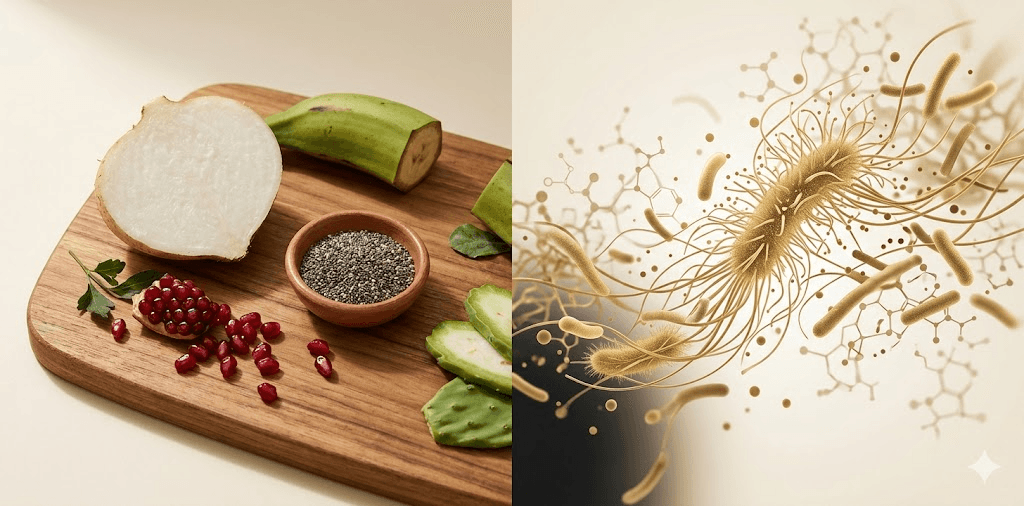
When a brand says "prebiotic" on its package, it is not telling you anything useful. It is like saying "vehicle": it could be a bicycle, a tractor, or a rocket. Each one does radically different things, and choosing one as if it were another is absurd.
The 2024-2025 science is finishing the job of showing the same thing with hormonal prebiotics. They are not a homogeneous class. Each one feeds specific bacteria, produces specific metabolites, and modulates specific hormonal pathways. And, critically for Lua: each one requires a baseline microbiome composition in order to work.
If a woman in perimenopause asks you which prebiotic to take, the honest answer is not a product — it is a question back: which bacteria do you already have?
Inulin: the best-documented "hormonal prebiotic" in humans
If we had to choose a single fermentable fiber with direct human evidence of hormonal modulation, it would be inulin.
Geng et al. (2025), published in Advanced Science, did what almost no one had done: a combined human + animal trial with crossed FMT (fecal transplant). Ten grams per day of inulin for 12 weeks, in women with polycystic ovary syndrome. The result was significant: hyperandrogenism improved, insulin sensitivity improved, and the glucolipid profile improved.
What matters is the mechanism. Inulin increased a "co-abundance group" dominated by Bifidobacterium and short-chain fatty acid-producing bacteria. That, in turn, reduced plasma LBP (LPS-binding protein), which lowered metabolic endotoxemia. Less circulating LPS means less TLR4 activation in the ovary — the same mechanism we documented in our previous research on dysbiosis and early menopause (Huang et al., 2024, Journal of Reproductive Immunology).
The closing experiment was elegant: the researchers performed FMT from the inulin-treated patients into gnotobiotic mice. The mice reproduced the effect: less hyperandrogenism, less ovarian inflammation, better insulin sensitivity. The microbiome modified by inulin, on its own, was enough to move hormones in another organism.
Clean mechanism. Direct human evidence. Known effective dose: 10 g/day for at least 8 weeks for a measurable signal.
And one data point almost no one communicates: jicama contains 10-12% natural inulin by fresh weight. A 150 g serving of jicama provides approximately 15-18 g of inulin — more than any over-the-counter commercial supplement. Artichoke, garlic, onion, and agave are also rich sources. Supplemental inulin in a pill is the industrial answer to a problem that traditional diets were already solving.
Resistant starch: four types, four destinations
Resistant starch (RS) is what happens when a starch avoids digestion in the small intestine and reaches the colon intact, where the microbiome ferments it. But RS is not one single thing.
- RS1: physically inaccessible starch, trapped inside matrices (whole grains, seeds, unground legumes). Slow, distal fermentation, broad profile.
- RS2: raw crystalline granule, present in green plantain, raw potato, and high-amylose corn starch. It specifically requires Ruminococcus bromii to begin its degradation.
- RS3: retrograded starch — the kind that forms when a cooked starch cools. Day-old nixtamalized tortilla, boiled and refrigerated potato, cold rice, next-day refried beans. Preferred substrate of Bifidobacterium adolescentis and Roseburia intestinalis.
- RS4: chemically modified. Not very relevant for natural diets.
The decisive study from the last two years is Li et al. (2024), published in Nature Metabolism. A randomized crossover trial in 37 humans with overweight: 40 g/day of RS2 for 8 weeks. Significant weight loss, improved insulin sensitivity, reduced hepatic steatosis. The enriched bacteria: Ruminococcus bromii, Bifidobacterium adolescentis, Faecalibacterium prausnitzii, Eubacterium rectale. Fecal butyrate rose from 8 to 12 mmol/kg in responders.
The key word is "responders". The study found three groups: enhanced, high, and low responders. The strongest predictor of ending up in the low group: baseline absence of Ruminococcus bromii. Without this keystone bacterium, RS2 is not degraded first, there is no cross-feeding toward butyrate producers, and the cascade breaks. Yang et al. (2024) confirmed in an independent replication that baseline composition and habitual dietary fiber predict more than 40% of the variance in response to RS.
The operational implication for a Mexican woman is direct. If Carmen took antibiotics several times last year and her diet has been low in fiber for a decade, she does not have R. bromii. Eating one green plantain a day is not going to do much for her — at least not through the butyrate pathway. RS3, in contrast, does ferment without R. bromii. Cooled nixtamalized tortilla, yesterday’s cold rice, tomorrow’s refried beans — routes the traditional Latin American microbiome had already figured out, even if no one called them prebiotics.
Polyphenols: third-generation prebiotics
Polyphenols are not fibers, but recent literature includes them in the functional prebiotic category. They modify microbial composition by inhibiting pathobionts and favoring bacteria such as Akkermansia muciniphila. But their most interesting feature is bidirectional: they require microbial biotransformation to become hormonally active.
- Daidzein (soy) → equol. Only 25-30% of Western women have the necessary bacteria (species of Slackia and Adlercreutzia equolifaciens). In Asian cohorts, the rate rises to 50-60% [García-Mantrana et al., 2018, Molecules]. Equol has much higher affinity for estrogen receptor β than the original daidzein. It is not the soy: it is the microbiome.
- Ellagitannins (pomegranate, raspberry, walnut, blueberry) → urolithin A. Approximately 40% of women are producers. Urolithin A induces oocyte mitophagy — mitochondrial quality of the egg — a pathway connected to reproductive longevity.
- Lignans (flaxseed, chia, whole grains) → enterolactone. Almost all women produce enterolactone, but at variable rates. Moderate affinity for estrogen receptor β.
- Resveratrol → dihydro-resveratrol. Higher bioactivity than the original compound.
- EGCG (green tea) → pyrogallol metabolites. Specific modulation of Akkermansia.
What matters for Lua: the same amount of soy, pomegranate, or green tea can have radically different hormonal effects depending on each woman’s baseline microbial composition. This is not a limitation of the compounds: it is information about metabolic individuality that population nutrition ignores.
LATAM fibers: the accessible catalog almost no one maps
The prebiotic literature is dominated by European and North American studies that test commercial supplements. The natural Latin American catalog stays off the radar. But it exists:
- Jicama: natural inulin 10-12% fresh weight. Raw, in juice, in pico de gallo. No industrial supplementation required.
- Nopal (Opuntia ficus-indica): mucilage + pectins. Remes-Troche et al. (2024), published in Nutrients, tested 300 mg/day of nopal extract for 8 weeks in people with dysbiosis: it reduced the Firmicutes/Bacteroidetes ratio and improved gastrointestinal discomfort. A 100 g serving of nopal provides approximately 1.5 g of mucilage — an order of magnitude higher than the supplemental extract.
- Chia: mucilage similar to nopal + 30% total fiber + lignans (enterolactone precursors).
- Beans (black, pinto): RS1 + RS2 + soluble fiber + oligosaccharides (raffinose, stachyose). Associated polyphenols (condensed tannins, anthocyanins) modulate microbial composition in parallel.
- Green plantain: almost pure RS2, 50-55 g of RS per 100 g of dry flour.
The prediction Lua Labs is formulating: Mexican women with high Latin American prebiotic diversity — jicama, nopal, chia, beans, green plantain, walnut, pomegranate — for 90 consecutive days report a Greene score 1.5σ below the mean for their age group, independent of estimated FSH. It would be testable with a formal cohort, explicit consent, and consistent longitudinal records, without needing microbial testing for every participant.
The part missing from the literature
Almost no prebiotic study measures what matters for female hormones. Most report alpha diversity, taxonomic changes, and short-chain fatty acids. Almost no one measures quantified fecal β-glucuronidase activity or urinary levels of 2-hydroxyestrone vs 16-α-hydroxyestrone (the markers that reflect estrogen detoxification).
It is a critical methodological gap. A study can report "inulin improved the microbiome" and still not answer whether that modified the estrogen cycle. The scientific literature is still in the phase of showing the "what"; the "how this translates into hormones" is a full decade of pending research.
Until then, the available evidence allows three honest operational conclusions:
- Inulin has direct human evidence of modulating ovarian function by lowering systemic inflammation (Geng 2025). Effective dose: 10 g/day, minimum 8 weeks.
- RS2 resistant starch requires baseline R. bromii to work. RS3 does not. In women with a history of repeated antibiotics or chronic Westernized diets, RS3 (cooled nixtamalized tortilla, cold potato, cold rice) is the robust route.
- Polyphenols modulate hormones only in people who have the bacteria to biotransform them. Metabolic individuality is not a detail: it is the main effect.
What Lua is building with this
Lua Labs’ full report on prebiotics and the estrobolome proposes three operational additions to the app:
- Prebiotic Density Score (PDS) computable from the current food log, with three differentiated routes: PDS-Estrobolome, PDS-Epigenetic, PDS-Phytoestrogenic.
- New tags in the food log: ellagitannin fruits (pomegranate, raspberry, walnut), natural inulin (jicama, artichoke), RS3 resistant starch (nixtamalized tortilla, cold potato).
- Onboarding questions: weekly intake of pomegranate or raspberry as a proxy for urolithin-producing capacity; tolerance to garlic and onion as a proxy for FODMAP response.
And one deeper question Lua Labs leaves open: what percentage of Mexican women are equol producers? And urolithin producers? Asian and European rates are published. Latin American rates are not. It is an evidence gap that can only be closed with our own cohort.
This article is based on the Lua Labs L1.5 report (2026-05-19). Main sources: Geng et al. 2025 Advanced Science; Li et al. 2024 Nature Metabolism; Yang et al. 2024 Gut Microbes; Remes-Troche et al. 2024 Nutrients; García-Mantrana et al. 2018 Molecules; Bian et al. 2023 International Journal of Molecular Sciences; Bendiks et al. 2024 Frontiers in Nutrition.
Lua does not prescribe foods or doses. It documents correlations and describes mechanisms. Clinical decisions belong to each woman with her physician.