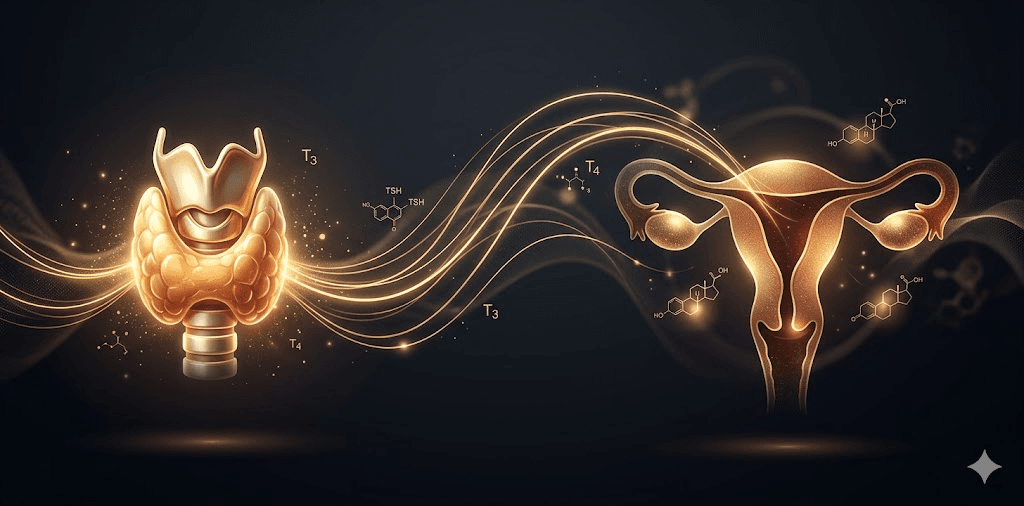
When people talk about female hormones, the focus almost always goes to estrogen and progesterone. But there is a gland in your neck — about the size of a butterfly — that acts as a silent conductor of the whole system: the thyroid.
Scientific evidence accumulated over the last 25 years shows that thyroid hormones do more than regulate metabolism. They directly modulate your menstrual cycle, your ovulation, and your hormonal response throughout the month.
Why the thyroid matters for your cycle
Your menstrual cycle is governed by the hypothalamic-pituitary-gonadal (HPG) axis: the hypothalamus releases signals, the pituitary gland responds with FSH and LH, and the ovaries produce estrogens and progesterone. What many people do not know is that thyroid hormones — T3 and T4 — are integrated into this system at multiple points.
T3 acts directly on hypothalamic neurons that produce GnRH (the signal that starts the whole cycle). It acts on the pituitary gland by modulating the synthesis of FSH and LH. And it acts on the ovary itself: the cells surrounding the follicle have T3 receptors, and T3 directly enhances FSH-mediated estradiol production.
In other words: if the thyroid is not working well, the signaling of the entire reproductive axis can become weaker or distorted.
Hypothyroidism: when the cycle loses its rhythm
A prospective study by Krassas et al. published in European Journal of Endocrinology evaluated 171 women with hypothyroidism and found that 23.4% had some menstrual alteration. The most common: oligomenorrhea, or cycles longer than 35 days. Another systematic review (Poppe et al., Human Reproduction Update, 2008) synthesized multiple cohorts and estimated that menstrual dysfunction in clinical hypothyroidism ranges from 20 to 40%.
There are several mechanisms:
1. Secondary hyperprolactinemia. When the thyroid produces too little, the hypothalamus raises TRH to compensate. But TRH also stimulates prolactin production — and prolactin suppresses GnRH pulsatility. Result: the cycle becomes longer or disappears.
2. Slow folliculogenesis. Without enough T3, follicular development slows down. Ultrasound follow-up studies in women with subclinical hypothyroidism found that 32% of their monitored cycles had no confirmed ovulation (Verma et al., Thyroid, 2012).
3. Luteal insufficiency. Even when ovulation does occur, the corpus luteum may function poorly. Low progesterone levels in the second half of the cycle can be the visible consequence.
4. Paradoxically, menorrhagia. T3 also regulates clotting factors. With hypothyroidism, these factors decrease and bleeding can become heavier and more prolonged.
What about subclinical hypothyroidism?
This is the form where TSH is slightly elevated but T4 is normal. A meta-analysis by Liu et al. (Thyroid, 2018) analyzed data from 2,413 women and found that subclinical hypothyroidism was associated with an 80% increase in the likelihood of anovulation (OR 1.8) and reduced pregnancy rates in fertility treatments.
Hashimoto: the immune system and the cycle
Hashimoto thyroiditis is an autoimmune condition. The immune system attacks the thyroid with antibodies (mainly anti-TPO and anti-Tg), and over time this can reduce thyroid function.
But here is the finding that surprises many women: thyroid autoimmunity can affect the cycle even when biochemical thyroid function is normal.
A study by Poppe et al. (Journal of Clinical Endocrinology & Metabolism, 2002) found that infertile women who were anti-TPO positive but had normal thyroid function had ovulatory dysfunction in 31% of cases, versus 14% in those without antibodies.
The proposed mechanism: some anti-TPO antibodies have cross-reactivity with ovarian tissue. In addition, the systemic inflammation associated with Hashimoto — with elevated cytokines such as IL-6 and TNF-α — can interfere directly with ovarian steroidogenesis.
Hashimoto, miscarriage, and PCOS
The epidemiological evidence in these areas is robust:
-
Miscarriage: A meta-analysis by Thangaratinam et al. published in British Medical Journal (2011) analyzed 28 studies with 19,640 women. The conclusion: positivity for antithyroid antibodies in euthyroid women was associated with an OR of 2.73 for miscarriage and an OR of 1.71 for preterm birth. Independently of thyroid function.
-
PCOS: A meta-analysis by Romitti et al. (Thyroid, 2018) that included 17 studies found that the prevalence of anti-TPO in women with PCOS is 26.0%, versus 9.7% in controls (OR 2.5). The relationship appears bidirectional: the elevated androgens in PCOS modulate the immune system, and Hashimoto-related inflammation may exacerbate insulin resistance in PCOS.
-
Endometriosis: A study by Somigliana et al. (Human Reproduction, 2006) found a higher prevalence of antithyroid antibodies in women with confirmed endometriosis (29%) versus controls (10%).
Iodine: not too little, not too much
Iodine is the material the thyroid uses to make its hormones. The WHO recommends 150 µg/day for non-pregnant adult women.
Iodine deficiency — still the leading preventable cause of hypothyroidism in the world — directly affects T3 and T4 synthesis. But there is a counterintuitive finding worth knowing.
A study published in New England Journal of Medicine (Teng et al., 2006) compared three regions of China with different iodine intake and found that excessive intake (> 300 µg/day) was also associated with a higher incidence of autoimmune hypothyroidism in women, especially in those with underlying autoimmune predisposition. The mechanism is the Wolff-Chaikoff effect: when faced with an acute iodine load, the thyroid temporarily inhibits hormone synthesis. In people with thyroid autoimmunity, this mechanism can persist and result in hypothyroidism.
Regarding pregnancy: a study from the ALSPAC cohort (Bath et al., Lancet, 2013) followed 1,040 pregnant women in the United Kingdom and found that low urinary iodine in the first trimester was associated with lower verbal IQ and reading skills in children at 8-9 years of age. A signal that maternal thyroid function during gestation has functional consequences for development.
Selenium: the selenoprotein that protects the thyroid
The thyroid gland has the highest concentration of selenium per gram of tissue in the entire human body. That is not a coincidence.
Selenium is a component of three families of proteins directly relevant to the thyroid:
- Deiodinases (DIO1, DIO2, DIO3): They convert T4 (the prohormone) into T3 (the active form) in peripheral tissues. DIO2 is the main source of intracellular T3 in organs such as the liver, muscle, and ovary.
- Glutathione peroxidases: They neutralize the hydrogen peroxide generated during thyroid hormone synthesis. Without sufficient activity from these enzymes, excess H₂O₂ damages thyroid tissue.
- Thioredoxin reductase: It regulates the cellular redox state in the thyrocyte.
What studies in Hashimoto show
Four lines of evidence converge:
A double-blind trial by Duntas et al. (European Journal of Endocrinology, 2003) divided 65 women with Hashimoto into two groups: 200 µg/day of selenomethionine or placebo for 3 months. The selenium group showed a 36% reduction in anti-TPO antibodies, versus 10% in the placebo group.
A later trial by Mazokopakis et al. (Thyroid, 2007) with 80 women and 6 months of follow-up confirmed the reduction in anti-TPO, but also observed that the effect partially reversed 6 months after supplementation was stopped.
A meta-analysis by Fan et al. (Journal of Clinical Endocrinology & Metabolism, 2014) that included 9 randomized trials (787 patients) confirmed the reduction in anti-TPO, but noted that the effect on serum TSH, T3, and T4 did not reach statistical significance across the studies.
A more restrictive meta-analysis by Wichman et al. (Thyroid, 2016) included only trials with low risk of bias and confirmed the effect on antibodies, but highlighted that no study had demonstrated benefit on clinical symptoms or patient-reported quality of life.
The interpretation: selenium seems to act mainly on the inflammatory/autoimmune component of Hashimoto, not directly on hormone synthesis. This is relevant, but it is not the same as reversing hypothyroidism.
A fact few people know: DIO3 in the ovary and uterus
Type 3 deiodinase (DIO3) — which inactivates T3 and T4 to protect tissues from overactivation — is expressed in the endometrium, ovary, and placenta. A study by Huang et al. (Journal of Molecular Endocrinology, 2011) in murine models found that DIO3 deficiency resulted in frequent anovulatory cycles, suggesting that local regulation of thyroid signaling inside the ovary and uterus has physiological relevance beyond serum hormone levels.
What science tells us (without prescribing anything)
Patterns emerge from this evidence:
The thyroid is not a system separate from your cycle. It is integrated into it. Persistent menstrual irregularities — very long cycles, absence of ovulation, severe premenstrual syndrome — may have a thyroid component worth evaluating with a doctor.
Thyroid autoimmunity (Hashimoto) can affect the cycle and fertility even when TSH, T3, and T4 values are normal. The anti-TPO antibody is relevant information even if it does not appear in basic routine lab tests.
The relationship between nutrition and the thyroid exists, but it is more complex than "eat more iodine" or "take selenium." Both iodine deficiency and excess can be harmful. Selenium shows a documented effect on autoimmune markers but has not been shown to reverse altered thyroid function.
And finally: variability is real. The selenium and iodine content of foods varies enormously depending on geographic region, season, and how they are produced. What is valid for a population in Western Europe may not apply in the same way to women in Mexico or Colombia.
This article synthesizes peer-reviewed scientific evidence. It does not constitute a diagnosis or medical recommendation. If you have questions about your thyroid function or menstrual cycle, consult a health professional.
Scientific references
- Krassas GE et al. (1999). Eur J Endocrinol, 140(6). doi:10.1530/eje.0.1400671
- Poppe K et al. (2008). Hum Reprod Update, 14(4). doi:10.1093/humupd/dmm045
- Poppe K et al. (2002). J Clin Endocrinol Metab, 87(2). doi:10.1210/jcem.87.2.8201
- Thangaratinam S et al. (2011). BMJ, 342, d2616. doi:10.1136/bmj.d2616
- Romitti M et al. (2018). Thyroid, 28(11). doi:10.1089/thy.2017.0348
- Somigliana E et al. (2006). Hum Reprod, 21(10). doi:10.1093/humrep/dei371
- Duntas LH et al. (2003). Eur J Endocrinol, 148(4). doi:10.1530/eje.0.1480389
- Mazokopakis EE et al. (2007). Thyroid, 17(7). doi:10.1089/thy.2007.0005
- Fan Y et al. (2014). J Clin Endocrinol Metab, 99(7). doi:10.1210/jc.2013-3991
- Wichman J et al. (2016). Thyroid, 26(12). doi:10.1089/thy.2015.0168
- Teng W et al. (2006). N Engl J Med, 354(26). doi:10.1056/NEJMoa054022
- Bath SC et al. (2013). Lancet, 382(9889). doi:10.1016/S0140-6736(13)60436-5
- Verma I et al. (2012). Thyroid, 22(3). doi:10.1089/thy.2011.0031
- Huang SA et al. (2011). J Mol Endocrinol, 46(3). doi:10.1530/JME-10-0200
- Rayman MP. (2000). Lancet, 356(9225). doi:10.1016/S0140-6736(00)02490-9