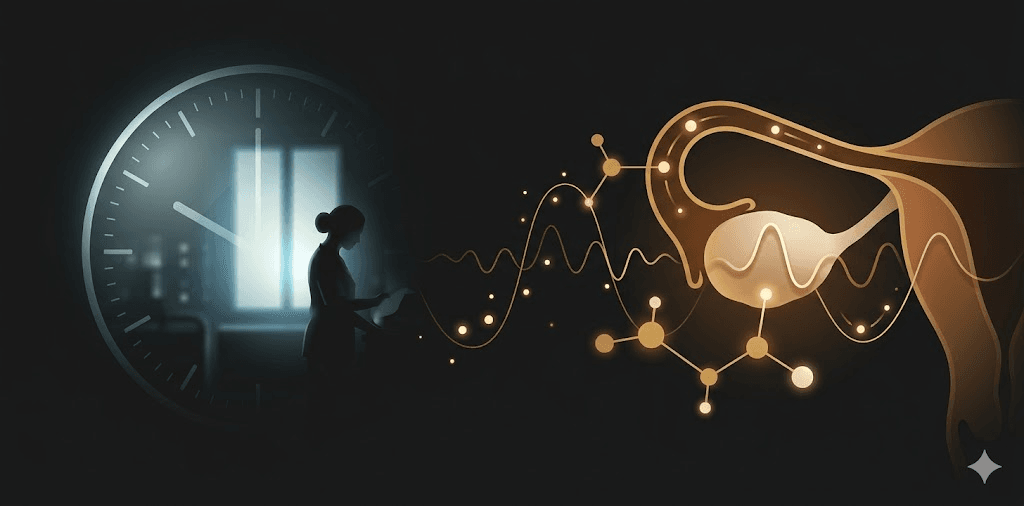
The night shift is not a late screen.
It is another clock living on top of yours.
When a woman works at night, her body does not just "sleep less." It has to be awake, exposed to light, alert, eating or drinking caffeine exactly when it was biologically expecting darkness, rest, and fasting.
That nuance matters. Because many conversations about sleep turn the problem into a list of individual habits: turn off screens, eat dinner early, lower stress, sleep eight hours.
But there are women who leave a hospital at 7 in the morning. Women who work in security, call centers, services, care, transportation, or retail. Women who get home and still have family responsibilities. For them, saying "improve your sleep hygiene" can sound like not having understood anything.
The question is not whether the night shift is "good" or "bad."
The question is more concrete: what hormonal signals are disrupted when work forces the body to live against its biological night?
The body registers the schedule, even if you did not choose it
The circadian clock is not a metaphor. The brain uses signals from light, darkness, food, activity, temperature, and sleep to organize physiology.
Nighttime light enters through the retina and tells the master clock that it is still daytime. Eating in the early morning gives metabolic signals when the system was expecting fasting. Caffeine sustains alertness when activation should be dropping. Work stress keeps the HPA axis active, the system that regulates cortisol.
The ovary is not outside that system either. Granulosa cells, theca cells, and the corpus luteum have peripheral clocks. In simple language: the ovary also interprets time.
That is why the night shift is not just fatigue. It is a collision of signals:
- light when the body expected darkness;
- food when it expected digestive rest;
- cortisol and alertness when it expected recovery;
- daytime sleep when the social environment pushes you to be awake.
What the studies show
In 2023, Hu and colleagues published a meta-analysis of 21 studies with 195,538 women. Shift work was associated with irregular menstruation, menstrual pain, and a signal of early menopause. The association was stronger in rotating night shifts and in women under 30 years old.
That finding does not mean every woman on night shifts will have irregular cycles. It means something more careful: there is enough epidemiological signal to stop treating work schedule as secondary data.
Lawson and colleagues, in the Nurses' Health Study II, studied more than 71,000 nurses. They found that recent exposure to rotating night shifts was associated with more irregular cycles and cycles of 40 days or more.
Mayama and colleagues observed in Japanese nurses that working six or more nights per month was associated with more irregular cycles and more amenorrhea. Wang and colleagues, in Chinese nurses, observed persistent changes in cycle length after starting rotating work.
Not all studies point in the exact same direction. Some see longer cycles. Others shorter ones. Others irregularity. That does not necessarily weaken the hypothesis. It may indicate that chronodisruption does not produce one universal response, but rather a loss of temporal coherence.
It is not just sleeping too little
One of the most common mistakes is reducing the night shift to "you slept less."
Sleeping less matters, but it does not explain everything.
Davis and colleagues measured hormones in nurses. During daytime sleep after night work, 6-sulfatoxymelatonin, a melatonin metabolite, was much lower than during nighttime sleep in daytime workers. They also observed changes in FSH and LH, hormones involved in the reproductive axis.
Fustinoni and colleagues, in 2025, studied female hospital workers on rapid rotation. They found a different steroid pattern: higher corticosterone, 11-deoxycortisol, DHEA, and androstenedione, and lower estradiol and vitamin D.
That is important because it shows that the problem does not always appear as "one low hormone." It may look like a different hormonal architecture: more adrenal signal, changes in steroids, less circadian coherence.
In Brazil, Brum and colleagues studied workers at a university hospital in the south of the country. People on the night shift slept close to 3.7 hours on workdays, compared with 6.7 hours in daytime workers. They also showed negative social jetlag and an attenuated cortisol rhythm.
That study is small, but it grounds the problem in a real Latin American context: we are not talking about biohacking. We are talking about work, daytime sleep, and insufficient recovery.
The hormonal phase changes the cost of the same shift
The same night shift can weigh differently depending on the hormonal moment when it happens.
A night of work in the follicular phase is not the same as a night of work in the luteal phase, the week before the period. In the luteal phase, after ovulation, progesterone rises. Basal temperature also usually rises. Many women sleep more lightly, have more sensitivity to caffeine, more cravings, more irritability, or more awakenings.
If you add white light at 3 in the morning, coffee to get through, food before dawn, work stress, commuting, and a morning when no one lets you sleep to that terrain, the margin for recovery gets smaller.
Not because of fragility.
Because of biology.
The Lua Labs hypothesis is that the luteal phase may function as a window of greater vulnerability to the night shift. Not because everyone responds the same way, but because progesterone, temperature, sleep, and the darkness signal are already negotiating a finer balance.
The useful question would be:
Do your symptoms after working at night change depending on the phase of your cycle?
That cannot be answered with one night. It is answered by observing patterns across several cycles.
Perimenopause: when the night gives notice before the calendar does
For Carmen, 47 years old, the pattern may look different.
In perimenopause, ovulation can become intermittent. Progesterone fluctuates. Estradiol can rise and fall without warning. Vasomotor symptoms may appear before the menstrual cycle becomes clearly irregular.
In that context, the night shift does not necessarily "bring menopause earlier." That phrase would be too simple.
The evidence on age at menopause and shift work is mixed. Stock and colleagues found signals of association between rotating night shifts and menopausal age. Khan and colleagues, in the Canadian Longitudinal Study on Aging, found a different relationship: some exposures to shift work were associated with later menopause.
That is why it is better to speak precisely. The most useful outcome for a woman in perimenopause is not always the exact age at menopause. It may be:
- fragmented sleep;
- awakenings with heat;
- nighttime palpitations;
- next-day fatigue;
- irregular energy;
- a sense of an erratic cycle;
- worse recovery after shifts.
The night shift could amplify a symptomatic transition before a clear change appears in labs or on the menstrual calendar.
The Lua Labs hypothesis: SWCD
Lua Labs proposed a research biomarker called SWCD, for Shift-Work Chronodisruption Dose.
It is not diagnostic.
It does not measure harm.
It does not turn night work into individual blame.
The idea is to estimate the dose of work-related chronodisruption by combining variables that are usually viewed separately:
- how many nights you worked in the last 14 or 30 days;
- whether the shift is fixed or rotating;
- how much you were able to sleep after the shift;
- whether you ate or had caffeine during the biological night;
- how much light or screen exposure there was during the shift;
- how much recovery time there was before the next obligation;
- which cycle phase or hormonal stage it happened in.
The difference is enormous. One isolated night does not weigh the same as six nights per month. A fixed night shift does not weigh the same as rotating every week. Sleeping during the day in silence is not like sleeping during the day with light, noise, heat, children, calls, or pending tasks.
SWCD tries to name that: the context that almost never fits into a consultation.
What Lua could measure
Lua does not need to measure melatonin in blood to ask better questions.
It can start with longitudinal context:
"Did you work at night or on a rotating shift in the last 7 days?"
If the answer is yes, the map could open simple questions:
- how many nights?;
- what time did the shift start and end?;
- were you able to sleep afterward?;
- did you eat before dawn?;
- did you drink caffeine during the shift?;
- what symptoms appeared afterward?;
- what phase or hormonal stage were you in?
Then that information can be crossed with sleep, energy, mood, cravings, pain, temperature, cycle phase, and perimenopause.
The value is not in saying "the night shift did this to you."
The value is in detecting whether a pattern repeats inside your body:
- night shift + luteal phase -> more pain or irritability;
- night shift + eating before dawn -> worse energy or cravings;
- night shift + perimenopause -> more awakenings or nighttime heat;
- rapid rotation -> more days of incomplete recovery.
That type of pattern is more useful than a universal recommendation.
The answer is not to prohibit. It is to map.
Many women cannot choose not to work at night.
That is why language matters. If the conversation sounds like "practice better sleep hygiene," it fails. If it sounds like "your shift damaged you," it also fails.
The more honest conversation is:
Your body is responding to a context. Let’s measure it.
Not to diagnose. Not to blame you. Not to promise that an app will solve working conditions.
So that when you say "after my shifts I feel out of sync," it does not remain a vague feeling. So you can see whether it repeats, when it repeats, in which phase, with which food, with which sleep, with which recovery.
That is longitudinal hormonal intelligence.
Sources
- Hu F, Han X, Chen X, et al. Shift work and menstruation: A meta-analysis study. SSM - Population Health. 2023. DOI: 10.1016/j.ssmph.2023.101542.
- Lawson CC, Whelan EA, Lividoti Hibert EN, et al. Rotating Shift Work and Menstrual Cycle Characteristics. Epidemiology. 2011. DOI: 10.1097/EDE.0b013e3182130016.
- Mayama M, Umazume T, Watari H, et al. Frequency of night shift and menstrual cycle characteristics in Japanese nurses working under two or three rotating shifts. Journal of Occupational Health. 2020. DOI: 10.1002/1348-9585.12180.
- Wang Y, Gu F, Deng M, et al. Rotating shift work and menstrual characteristics in a cohort of Chinese nurses. BMC Women's Health. 2016. DOI: 10.1186/s12905-016-0301-y.
- Davis S, Mirick DK, Chen C, Stanczyk FZ. Night shift work and hormone levels in women. Cancer Epidemiology, Biomarkers & Prevention. 2012. DOI: 10.1158/1055-9965.EPI-11-1128.
- Brum MCB, Dantas Filho FFS, Schnorr CC, et al. Effect of night-shift work on cortisol circadian rhythm and melatonin levels. Sleep Science. 2022. DOI: 10.5935/1984-0063.20220034.
- Fustinoni S, Campo L, Colosio C, et al. Steroid hormones, vitamin D and melatonin in rapidly rotating shift female hospital workers. Toxicology Letters. 2025. DOI: 10.1016/j.toxlet.2024.11.013.
- Stock D, Knight JA, Raboud J, et al. Rotating night shift work and menopausal age. Human Reproduction. 2019. DOI: 10.1093/humrep/dey390.
- Khan D, Rotondi MA, Behdin N, et al. The association between shift work exposure and the variations in age at natural menopause among adult Canadian workers. Menopause. 2022. DOI: 10.1097/GME.0000000000001981.