“Your thyroid is fine.” They told you that while looking at one number: TSH. And yet, there you are — feeling cold when everyone else is comfortable, tired for no clear reason, with cycles that change from month to month and brain fog that does not lift in the morning.
You are not making it up. Recent science shows that TSH within the “normal range” does not rule out a problem. In fact, there is an increasingly well-documented pattern that a single TSH test cannot capture.
TSH is not a precise thermostat. It is a pressure indicator.
The popular idea is that TSH is the “definitive marker” of thyroid function: if it is in range, everything is fine. But TSH only measures one part of a system with at least five layers:
- The TSH circulating in your blood.
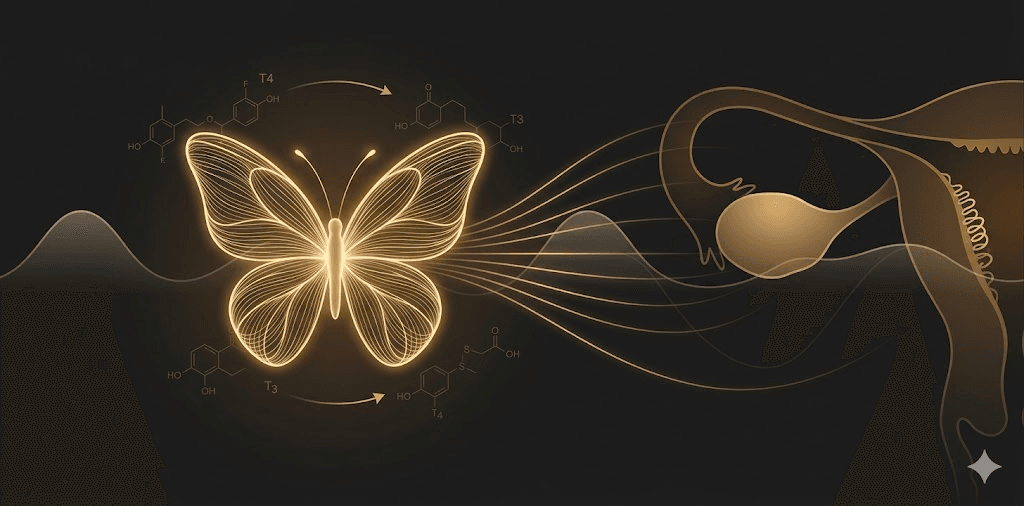
- The conversion of T4 (the storage hormone) into T3 (the active hormone) inside each tissue.
- The sensitivity of your receptors to that active hormone.
- A local signal inside the ovary itself (thyrostimulin) that clinical endocrinology does not even measure.
- The timing of the sample: TSH changes throughout the day and across the cycle.
When you only look at the first layer, you can miss failures in the other four.
Why a single measurement is not enough
The BioCycle study (Plowden, 2018), which followed 259 healthy women with multiple measurements, documented something clinical practice often ignores: TSH varies across the menstrual cycle. It is higher at mid-cycle and lower in the early follicular and late luteal phases. On top of that, it has a circadian rhythm with a nighttime peak.
The consequence is direct: a single TSH measurement, taken on any given day at any given hour, is a snapshot of a moving number. For mild subclinical hypothyroidism, that makes it diagnostically weak.
The diagnostic gray zone: 2.5 to 4.0 mUI/L
Here is one of the most uncomfortable points in current thyroid medicine. At what TSH value is it considered “high”?
The typical upper limit (around 4.0–4.5 mUI/L) comes from historical cohorts that included people with undetected thyroid autoimmunity. When those people are excluded, the real limit moves closer to 2.5–3.0 mUI/L.
The 2024 ASRM guideline recognizes this: in women with fertility problems, a TSH above 4.12 mUI/L is treated; between 2.5 and 4.12, it is treated only if anti-TPO antibodies are positive. In other words, there is a huge gray zone where a significant share of symptomatic women live, and where even specialists do not fully agree.
The regional data makes this more concrete. In a study of 1,496 Mexican women (Carrillo-Lozano, 2021), the prevalence of subclinical hypothyroidism was 40.7% if the 2.5 mUI/L threshold was used, compared with 14.7% using the 4.1 threshold. The same group of women, two radically different diagnoses, depending on where you draw the line.
How chronic stress leaves you “functionally hypothyroid”
This is the bridge connecting the thyroid with everything else Lua studies.
Chronically elevated cortisol does three things to the thyroid system, none of them visible in an isolated TSH:
- It flattens the nighttime TSH peak by inhibiting the signal from the brain.
- It degrades the DIO2 enzyme, which converts T4 into active T3 inside tissues. Less conversion means less hormone where it is needed.
- It diverts T4 toward rT3, an inactive form, instead of toward T3.
The result is the pattern “normal TSH + normal T4 + low T3 + hypothyroid symptoms.” Classical medicine sometimes calls this “euthyroid sick syndrome,” but in women with chronic stress it is, in reality, a regulatory mechanism that silently reduces active hormone.
The cleanest model of this effect is seen in Cushing’s syndrome (Benvenga, 2021): with massive cortisol excess, T3 falls disproportionately, and after cortisol is corrected, T3 recovers earlier and more than T4. The cortisol → thyroid arrow is real and reversible.
Genetics: the gene that is different in 1 out of 7 women
Not all women convert thyroid hormone in the same way. The DIO2 enzyme — the one that activates the hormone inside tissues — has a common genetic variant called Thr92Ala.
Around 13 to 15% of the population carries it in homozygous form, and that reduces enzyme activity by about 30% (Luongo/Colella, 2023). These women have less active hormone in the brain, muscle, and ovary — with blood tests identical to everyone else’s. They also tend to respond worse when they receive only levothyroxine, because that pill depends precisely on the conversion they have limited.
It is one of the reasons two women with “the same normal TSH” can feel like they are living in completely different worlds.
Thyroid and perimenopause: a confusion that is now official
If you are between 40 and 55 years old, there is another layer. The symptoms of an under-functioning thyroid and the symptoms of perimenopause overlap so much that the average clinician can confuse one with the other: menstrual irregularity, mood changes, sweating, sleep disruption, hair loss, fatigue.
In 2024, the European Menopause Society (EMAS) formalized this overlap: every woman in the perimenopausal transition should be evaluated for thyroid dysfunction, and vice versa. It is the first time a medical society has made this an explicit recommendation. Underdiagnosis, they acknowledge, is the rule rather than the exception in this age range.
Self-knowledge, not diagnosis
This is where we want to be very clear. None of this means you should self-diagnose hypothyroidism. Lua does not diagnose, does not interpret lab tests, and does not recommend doses or protocols.
What does make sense is recognizing a pattern over time: persistent cold, loss of the outer third of the eyebrows, constipation, morning brain fog, facial puffiness on waking, weight that resists diet, heavy menstrual bleeding. When several of these coexist with irregular cycles and chronic stress, it is a pattern worth bringing to a consultation — asking for a complete thyroid panel (TSH, free T4, free T3, anti-TPO, and anti-Tg), not just an isolated TSH.
That is the difference between a single number and a story. Your body is speaking to you over time. The thyroid is one of the hardest voices to hear — because it hides behind a lab test that says “normal.”
This article summarizes peer-reviewed scientific evidence for educational purposes. It does not replace individual medical evaluation. If you recognize yourself in this pattern, consult a healthcare professional.